Tuesday, January 22, 2013

Musial, Weaver, and the Wandering Kings


Stan Musial and Earl Weaver


This week saw the passing of two baseball greats, Earl Weaver and Stan Musial. Although in some ways these two personalities could not be further apart – one the steady consummate gentleman, the other the impulsive firebrand – there are some interesting parallels between the two men. Musial, of course, spent his entire 22-year career with the St. Louis Cardinals. Weaver, while never appearing in an official major league game, came up with the Cards organization, and spent part of spring training of 1952 with the Redbirds, where his fiery temperament apparently made him know. (Here he is below, wearing the leftover ’51 Cardinal road uniform). The two men were in the same lineup exactly one time: One March 8, 1952 the Cardinals faced the Yankees with Weaver put in the lineup, replacing regular second baseman Red Schoendienst (as Cardinal player-manager Eddie Stanky was also a second-sacker,  Weaver’s chances of making the club were slim to none). The normally light-hitting Weaver went 2-for-5 (Musial was 1-for-three), but Earl didn’t make the big club, and played for the Houston Buffs that season. His lack of hitting ability kept him out of the majors, but the Orioles saw managerial potential in him, and the rest is history.

An interesting stat about Stan The Man: Although he played for Cards for 22 seasons, he appeared in 24 All Star Games. How was this possible? The interleague classic was played twice a season from 1959-1962.


Kings Wanderlust Continues

The news broke this week that the NBA’s Sacramento Kings will likely be coming to Seattle next season. If this happens, the club will adopt the departed Sonics’ name and colors, but Seattle will actually be getting one of the NBA’s original franchises. In fact, the team pre-dates the NBA by decades, starting in the 1920s as an semi-pro club sponsored by the Seagrams booze people in Rochester, NY. The team changed its name to Royals when they went professional and played in the National Basketball League and Basketball Association of America before teams from those two leagues combined to form the NBA in 1945. In 1957 the club moved to Cincinnati and seemed content until the journey west continued and they became the Kansas City-Omaha Kings for the 1972-73 season, with home games split between two cities. In 1975, the “Omaha” was dropped, and ten years later KC was abandoned as well in favor of Sacramento. So, assuming the Seattle move goes through, and counting Omaha, this franchise will have called six cities home, giving “traveling” in basketball a new meaning. Six home towns is also easily the record for North American major league sports teams.* While redeemed Seattle fans bask in the past glory of Spencer Heywood, Shawn Kemp, and Gary Peyton , perhaps the players from past years to be celebrated should be the likes of Al Cervi, Red Holzman,  and Tiny Archibald.

*It has been pointed out that the Nets franchise (who started life in the Teaneck Armory as the ABA’s New Jersey Americans and now grace Brooklyn’s new Barclay Center) have played more different cities than even the Royals/Kings, however they have only been known as the New Jersey Nets, New York Nets, and Brooklyn Nets (in addition to the Americans).

Thanks to EFF customers Kenneth Mall, Adam Klawitter, and Paul Dylan for contributing research to this post.

Monday, August 13, 2012

Let's Talk Dives...

Ladies and gentlemen pull up a chair - or rather a bar stool - as the subject of this month's missive is...dives. No, not that kind. I know the Olympics just ended and this is supposed to be a sports-related blog, but I mean real dives. The kind of place that you might not bring your parents or a first date to, but which otherwise fits you like a glove. A really comfortable, tipsy glove. Every one's definition of what makes a good dive is different, but here's my criteria: 1. It must be relatively cheap. 2. It must be free of pretension. It is exactly what it is - no more, no less. 3. It must be immune to gentrification or hipsterization (ok, I made that word up, but it describes a real social ill). 4. It must attract characters - both as patrons and employees. 5. (and this one is really important): It must make both regulars and newcomers feel welcome.

I happen to be in Los Angeles while I write this, so I will discuss two of my favorite L.A. dives, Chez Jay's in Santa Monica, and the HMS Bounty in Koreatown. I discovered each of these joints quite by accident and have returned to both countless times and have never been disappointed. First, Chez Jay. I first stumbled into this little seafood shack across from Santa Monica pier in the early 90s, but Jay's has been serving stiff drinks and seafood to folks since locals pronounced a hard "g" in "Los Angeles". I will never forget the way owner Jay Fiorendella greeted me at the Dutch door entryway the first time, resplendent in a suit with open-necked shirt - with the words "Hello, I'm Jay". (OK, not very dive-like, but bear with me). The crunch of peanuts and sawdust on the floor, red and white checked tablecloths, and seafairing bric-a-brac on the walls sets the mood. A bar takes up most of the space on the left side. The food here will never receive a Michelin star, but it's quite serviceable (the Steak Sinatra is my personal favorite), and when combined with the low lighting and 1960s ambience (I'm talking Mad Men 60s, not Haight-Ashbury 60s) more than makes up for any lack of haute cuisine aspirations. On one of my early visits I was chatting with Jay when he pointed to a  stool a few yards away. "See that chair?", he said. "That's where Angie Dickinson would wait for a call from Peter Lawford telling her where to go meet Jack." (That's Jack, as in Kennedy. The young president was also rumored to favor the private back room for trysts). On my last visit, in October, I was saddened to learn that Jay had passed away a few years ago. But the place was still going strong. Steak Sinatra was still on the menu, and the same faded UCLA pennants were on the wall, next to the ancient metal diving suits. The jukebox shuffled from Chuck Berry to Roy Orbison to Steppenwolf. The lovely bartender was cracking wise, and when a hipster asked for an "energy drink" we all held our collective breath. "This is a bar, honey", was all she said. It sure is.


Note: I just read that wrong-headed civic planners (read "morons") are trying to have Chez Jay's replaced by a more tourist and family friendly restaurant (as if Santa Monica doesn't have enough of those). Read about it here.

I had the pleasure of discovering the HMS Bounty more recently when I started using Koreatown as my base during my L.A business trips. This stretch of Wilshire Blvd. is a treat for Los Angeles history buffs. The famed Brown Derby restaurant was next door, and the Ambassador Hotel, site of Robert F. Kennedy's assassination in 1968 was across the street, as was the Coconut Grove nightclub. Founded in 1948, the Bounty was at different times a haven for sports bookies, and one of L.A.'s great pick-up bars (due to all the single gals living in the nearby apartment buildings in the 1960s). The Bounty itself is nestled in the lovely art deco Gaylord Apartment building, still home to aspiring actors and other interesting Angelenos of all stripes. Baseball games play on flatscreen TV's in the corners, but this is the Bounty's only concession to modernity. Another nautically-themed establishment (a thing with me, I guess), the HMS Bounty attracts an interesting combination of lower show biz life, hipsters, and Gaylord residents. I was there on a Monday night recently and the place was crawling with old jazzmen talking shop. If you squint in the light of the nautical lanterns you will see photos on the wall of long-forgotten sax players ("Corky Corcoran - Sensational Young Tenor Star - Endorses Conn Saxophones"), or 1940s entertainers like the Harry James Orchestra. The great jukebox follows suit, with selections by Dean Martin, Glenn Miller, and Artie Shaw. For serious diners, there is a separate formal dining room, which is rarely used. I prefer to take my meals at the bar or at one of the big banquettes in the same room. Best of all, the bartenders and servers always seem to be having as much fun as the patrons. When nature calls (which it surely will after your third gin and tonic), one steps through a side door into the ornate lobby of the Gaylord where the public facilities are located. One can meander (or stumble) back toward the HMS while appreciating the fine architectural details as well as the historic photographs of the building (so you can get your buzz on and your culture in one setting). I was just there before writing this, and I'm going back tomorrow.

What are some of your favorite dives? Let me know and maybe I'll post some of them (or better yet, visit). Until next time, pass the nuts.

Thursday, May 31, 2012

A Goodbye To Our Friend Mr. Surkin

I received a phone call early in May from my dear friend and sometime mentor, sometime competitor, Peter Capolino. Peter founded Mitchell & Ness Nostalgia Co. in Philadelphia around the same time that Lisa and I were starting up EFF, and I suppose it was inevitable that the only two lunatics attempting to re-create a dead athletic apparel product at precisely the same time when the entire U.S. manufacturing base was in serious decline get together. We all became fast friends in those early, heady days, and often shared resources and knowledge. (More on that friendship at another time). Peter was calling to tell me that Martin Surkin, owner for many decades of Maple Manufacturing Company was not long for this world, and that perhaps I should call him and say my goodbyes. I had not spoken to Mr. Surkin in several years, and he sounded initially distant and somewhat confused by my call, though he fortunately soon realized who I was, and we had a pleasant, though brief, chat. I was grateful that I had a chance to express my thanks to him and tell him how much he meant to us.


Back in the late 1980s when we decided to start a baseball clothing company there were still a number of old time manufacturers who made the very items from the "golden age" of athletic apparel we were trying so hard to emulate in our business. My first caps, for example, were made by a little company in Boston's Chinatown who used to deliver the Red Sox hats right to the clubhouse at Fenway. There were still a few woolen mills and jacket makers around (all gone now), and I visited or called all of them in the first years of EFF's existence, soaking up every bit of knowledge I could. Maple was one such company, and I met Martin Surkin and his sister Pearl through Peter, who was using Maple to make all of his flannel baseball jerseys at the time. Mr. Surkin had acquired Passon Sporting Goods around 1933. Its founder, Harry Passon, was instrumental in outfitting the many black and Jewish athletic teams in the Philadelphia area and was also a co-founder (with Eddie Gottlieb) of the Philadelphia SPHAs professional basketball team.

Going to Maple was always a bit of an adventure. The company - on Noble Street in the Callowhill section of Philadelphia - was in the Art Deco Lasher Building. What once had been a beautiful, modern edifice was now a crumbling relic. The elevator ride to Maple's offices and factory was a bit creepy, and on my ride up to the fourth floor I always felt vaguely like I was traveling through ghosts of Philadelphia's industrial past, which in a way I was. Although once in the confines of Maple it was perfectly fine, by the 1990s neither the building nor the neighborhood were places one would want to linger after dark.

Mr. Surkin - I could never quite bring myself to call him "Martin", it seemed almost disrespectful - was an interesting man. He walked with a pronounced limp (a vestige of childhood polio), carried a cane, and smoked a pipe. He never married. He lived with his sisters Natalie (who passed away before I met him) and Pearl, who did Maple's bookkeeping. On his desk was always a jar of pretzels. He seemed to have no hobbies or vices other than buying himself a new Cadillac every year, and going to DiNardo's on Race Street for steaks or crab nearly every night. He was the first person I knew who watched his stock portfolio on a computer. He was thoughtful, very intelligent, enjoyed a good joke, but did not suffer fools gladly. To me he was a wise old sage, and I would pester him questions about how things were done in the good old days. I always got the impression he must have been somewhat amused that these younger people had so much fascination for something that to him must have been old hat.


Pearl handled the bookkeeping, and she was a character in her own right. Under five feet tall, with a cigarette dangling from her mouth, and enough hairspray to turn her head into a silver helmet, she could play the sweet Jewish grandmother. But if you crossed her (especially if you owed Maple money) she could be tough as nails. Her worst insult was "oh go sit on a tack!" And she meant it.


Martin and Pearl Surkin


Mr. Surkin may have seemed like a kindly grandfather at times, but he could be very tough about business. Throughout much of the 1990s, we made David Letterman's annual big Christmas gift to staff and friends, which was always a varsity style wool and leather jacket. These jackets went to famous friends like Johnny Carson and Tom Hanks, as well as to the show staff. Dave himself took an active role in the design each year, often designing and re-designing the jacket right up until the point of production. This order was a big deal for us - both financially and for the prestige we gained from it. One particular year, it must have been around 1994, we had Maple make the Letterman jackets, and as Christmas approached, we grew concerned about Maple's delivery. This concern was heightened when Dave's personal assistant Laurie Diamond called me (almost never good to pick up the phone and have "Diamond", as she liked to call herself, on the other end). She was clearly alarmed that the jackets were not going to make it in time, and franly,  so was I. No Christmas jackets meant no $50,000 payment, which funded the company through the first slow post-holiday months; a very disappointed David Letterman, and one very pissed off Laurie Diamond. I made a call to Mr. Surkin. Ebbets Field had a bit of an overdue balance to Maple at the time, and Mr. Surkin made it clear that without us becoming current on that balance, he could not assure us that the David Letterman Christmas order would have priority in his production schedule. Not having the cash on hand, I explained that when we got paid for the Letterman jackets we would have plenty of money to pay our back balance, and how it would adversely affect my business if we were to not deliver these jackets on time, but Mr. Surkin was unmoved: The jackets "might" make it, or they might not. No guarantees, when I guarantee was what I desperately needed.


I made a snap decision to take the red eye that very night to Philadelphia and try to take charge of the situation. For a week I trudged into the Noble St. factory at 9 AM with the rest of the employees. Mr. Surkin neither hindered nor helped me. Early on I figured out who made things happen in the factory and made sure I became friendly with the people who would decide my fate - or at least my relationship with my biggest and most important customer. I begged, pleaded, and cajoled Maple's employees to push my jackets through the production line. I pressed jackets, trimmed threads, counted garments, and packed them into boxes. This being a Union shop, perhaps the worse thing was seeing boxes of jackets nearly ready for Fedex at 5 PM, but when 5 o'clock struck, the shipper put his hands down, even though five more minutes of taping boxes shut would have meant dozens of Letterman Christmas jackets going out that day instead of the next. The situation was not made better by periodic phone calls from Laurie Diamond, who had somehow tracked me down at Maple, demanding progress reports and assurances. I dealt with all the pressure by copious drinking in the evenings with a few sympathetic Mitchell & Ness employees and their friends. But the next morning I would make my way through the December muck back to my work station at Maple. On my breaks I would retreat to the fortress of an office where Martin and Pearl held forth. I would eat my lunch while behind me Pearl would type Maple's invoices by hunt-and-peck method on an electric typewriter (she refused to learn to use a computer), while smoking a cigarette and carrying on a running commentary to no one in particular on the quality of their customers. "Six jackets," tap-tap, drag, puff...."Like he's doing us a favor!"...TAP, TAP, TAP!


The Lasher Bldg., home of Maple Mfg.


By the end of my week-long "apprenticeship" at the factory the jackets got out - barely. To add insult to injury, I missed my flight back to Seattle when the airport shuttle driver agreed to turn around at JFK and take a passenger to La Guardia when the passenger realized he was headed to the wrong airport. I capped off my trip East by spending a miserable night at an airport hotel. We paid for the Letterman jackets as well as the back balance we owed, and despite the stress this experience caused me I always respected Mr. Surkin for taking the stand he did. I knew it was just business - just like Mr. Surkin knew our decision to give the Letterman jacket order to a different supplier the following year was just business.

  
 We continued to use Maple periodically over the next several years, but advancing age and a changing sporting goods market meant Mr. Surkin finally had to sell Maple in the late 1990s. The new owners were full of big plans, but they ran the company into the ground almost instantly, ending over 60 years of apparel-making heritage. In the meantime Pearl passed away and Mr. Surkin eventually had to move into an assisted living facility.


Mr. Surkin passed away on May 12th, 2012 at the age of 92, a few days after our phone call. He was a friend to us, and a mentor whom I learned a great deal from. I keep a Maple catalog from 1941 on my desk and leaf through it from time to time. The rough, aged paper feels good in my hands, and the work Mr. Surkin did over 70 years ago is still an inspiration. I am a better businessman - but more importantly a better man - for having known him. 


Thursday, March 1, 2012

The Fits And Starts Of Baseball Integration

By now even the most casual baseball fan is familiar with the story of Jackie Robinson and his breaking of the "color line" in organized baseball. Robinson's fearlessness, temperament, grace, not to mention pure baseball ability and exciting style of play, made him the perfect symbol of the changing of the guard in the fusty world of professional baseball from the Old to the New. In Branch Rickey, we have the perfect benevolent and wise father figure, who ushered in the new age of enlightenment in the face of resistance from his less reasonable brethren - his fellow owners. Like many mythologies, the story, although over-simplified, has the power over us that it does because it is basically true. But integration in baseball did bot begin with Robinson, nor sadly, did the floodgates of goodwill and fairness toward African-American players open immediately after Robinson's heroic first seasons.

Left: Charlie Grant, or "Charlie Tokohama".

As far back as 1901, the very first year of what is considered the "modern era" of major league baseball, efforts were made to challenge - or at least circumvent - the so-called "gentleman's agreement" which barred only black players from the game. In that season John McGraw of the Baltimore Orioles (forerunners of the franchise we know today as the New York Yankees) hired one Charlie Grant, and tried to pass him off as Native American "Charlie Tokohama". When many of Grant's suspiciously non-Indian looking friends came out to the ballpark to see "Tokohama" play, McGraw's ruse was exposed, and the experiment quickly ended.

In 1916 Canadian Jimmy Claxton was briefly signed by the Oakland club of the Pacific Coast League, again using the Native American ruse, and Claxton's time with the Oaks ended as suddenly as it began. It would be 30 year before the PCL would see another black player.

The great baseball owner and raconteur Bill Veeck often stated that he tried to buy the hapless Phillies in 1943 and stock them with top Negro league stars. Although it is very easy to believe that Veeck's lively mind came up with this idea, there is scant evidence beyond Veeck's own claims to suggest he ever tried to go through with it.

The big bats of the Washington Homestead Grays.

Another story has to do with Senators owner Clark Griffith watching the Homestead Grays (who played home games in Washington) take batting practice. It didn't take much more than seeing Josh Gibson and Buck Leonard crush ball after ball out of Griffith Stadium for him to realize what kind of team the lowly Senators would be if he could sign these sluggers. But alas it was not to be.

Then there is the story told to me by Cuban baseball historian Edel Casas in Havana many years ago: Branch Rickey had been looking for that special player for some time before he eventually set his sites on Robinson. The Dodgers used to play exhibition games in Cuba and the great slugging shortstop and pitcher, the dark-skinned Cuban player Silvio Garcia went 8 for 21 against the Brooklyn club in a 1942 exhibition series. Rickey supposedly asked the Cuban the same question he would later pose to Robinson: "What will you do the first time a white player slaps your face?" Garcia's answer? "I will kill him". Needless to say, Garcia was not chosen to fulfill the role Rickey had in mind.

It should also be noted that the minor leagues - as part of organized baseball - followed the same rigid code of segregation as the majors, but there were pockets of resistance. The Provincial League of Quebec was a haven for black ballplayers during the years when the league was "independent", and therefore not subject to the strictures of organized ball. But when the league joined organized ball as a Class C circuit, the ban on black players was strictly enforced. In the South - with Jim Crow laws very much still on the books - the story was predictable. The most important loop - the Southern Association - never did integrate, a fact that partly explained its demise in 1960. When the Hot Springs Bathers tried to field two black pitchers in 1953, the club was initially ousted from the league, and a major crisis ensued for minor league baseball.

Left: Elston Howard as a Kansas City Monarch

Let's look at the majors post-1947, when one might think that after having seen Robinson succeed in the majors, and knowing full well the depth of talent available in the Negro leagues, that there would have been a rush from all sides to scoop up the best players. Yet this didn't happen. Teams like the Dodgers and Giants were very aggressive in signing black (and later Hispanic) players, and clearly benefited from the infusion of talent and excitement stars like Robinson, Satchel Paige, Willie Mays and Hank Aaron brought to their new clubs. At the other extreme, the Boston Red Sox simply found it quite impossible to find the "right" black player for over a decade. It was not until 1959 that the Bosox grudgingly brought up the frankly mediocre Pumpsie Green to "integrate" the club as its sole African-American member. The great and mighty Yankees looked far and wide before settling on Elston Howard. "The Yankees will bring up a Negro as soon as one that fits the high Yankee Standards is found", sniffed GM George Weiss. It was not until 1955 that Howard was finally found fit for pinstripes. This event was greeted by a comment from Casey Stengel too vulgar to post here, but it should be noted that Howard always said he was made to feel welcome by his Yankee teammates.

Two pioneers: Larry Doby and Jackie Robinson

Nor was each league equal in the pace of integration. Until at least the mid-1960s, the National League far outpaced the American in signings of African-American players. Cleveland (with Bill Veeck in charge) took the lead in the junior circuit by signing Newark Eagles star Larry Doby (who had to go through the same tribulations in 1947 as Robinson, with far less fanfare and without the benefit of seasoning in the minor leagues that Robinson had). The Indians also have the honor of fielding the first black manager - Frank Robinson - in 1975.

So, as we rightly celebrate Robinson and Rickey, it is appropriate to also be cognizant of the struggles before that triumphal year of 1947, and the ones that continued for too long a time after.

Monday, October 24, 2011

The DH and Other Strange Rules

I was recently on a Rolling Stones discussion site when the subject of the Designated Hitter rule came up (of all things). If there is one sure fire way to stir up the cyber equivalent of a bar fight among baseball fans, just type "I hate the DH" (or "I love the DH") and wait for the fun to begin. But the discussion got me thinking about odd or unusual rules in baseball and other sports. I do not wish to make this month's edition of FOTM exclusively about the DH, so allow me to dispense with it here, before moving on to our main topic:

Connie Mack first advocated use of a designated hitter in 1906.

In my humble opinion, the designated hitter rule is an abomination against God and Nature, a scourge on the National Game, a violation of the most basic and sacred tenets of baseball, and contrary to all that is Right and Good in the universe. It is a permanent solution to a temporary problem. Among its many evils is that it has immeasurably dumbed down the game, taught two generations of pitchers that they needn't bother to learn how to use a bat, and is based on the false premise that more offense necessarily makes a better game. Worst of all, it violates the very first rule in the rulebook, which says "Baseball is a game of two teams of nine players each". Get that? Nine. Not ten, eleven or fifteen. You want a historical reason I'm against it? Okay. If the DH rule had existed at the time, there would have been no Babe Ruth, as Ruth was a pitcher and his batting prowess might never have seen the light of day in a major league game.


Ron Blomberg became the American League's first designated hitter on April 6, 1973. He was walked by Luis Tiant.

I can almost hear some of you go for your keyboards already. Please save yourselves (and me) some time. Yes, I know I am in the minority. I know that most "fans" prefer the DH. I know that virtually all professional and college leagues use it. I know it isn't going away. I know that you "don't pay to see managers manage". I have heard all the arguments. I've heard them and I remain unconvinced. The DH is an artificial and completely unnecessary rule, and the fact that it is still around is an embarrassment, akin to someone you know wearing an open necked polyester shirt with gold medallions long after the disco era ended. (The 70s were not a great era for baseball rule changes or popular music, but unlike the Bee Gees, the DH is still inexplicably with us). Even the name of the position - "designated hitter" - sounds forced and artificial. Yes, lots of fans prefer the DH. Lots of fans are wrong. Glad I got that off my chest, let's move on...

A rule that has always intrigued me is the uncaught third strike rule. This rule (No. 6.09) states that if there are two outs or first base is open, a strikeout victim can advance to first if the ball is not cleanly fielded by the catcher on the third strike. In one of the best examples of the wonderful symmetry of baseball, it was thought that the failure of the batter was not enough to cause an out - the defense must do its part too. In the instance where a batter reaches base successfully the pitcher is credited with a statistical strikeout, but no actual "out" is recorded. (This means that it is technically possible for a pitcher to have four or even more strikeouts in one inning). Of course, throwing the runner out is usually a formality, but in the 1941 World Series this play loomed large. With the Brooklyn Dodgers about to tie the Series at two games each, Mickey Owen's passed ball on what should have been the game-ending pitch by Hugh Casey allowed the Yankees to eventually turn the game around and take a 3-1 Series lead over Brooklyn. New York went on to win the next day and take the Series. One of the writers at the time described it like this: "The condemned jumped out of the chair and executed the warden". (Poor Mickey Owen, no one remembers that in the same season he set a National League record for most chances without an error by a catcher. When he passed away, his New York Times obituary was headlined "Mickey Owen Dies at 89, Allowed Fateful Passed Ball").

Let's turn to the great game of American football. In the early part of the 20th Century the drop kick was a popular way to score field goals and extra points. But by 1934 forward passing had become such a big part of the game that the shape of the ball was made pointed and could no longer be dropped with a reliable bounce. The last successful drop kick for decades was made by Roy "Scooter" McLean of the Chicago Bears (left) against the New York Giants in the 1941 Championship game (Joe Vetrano of the 49ers kicked one against the Browns in 1948, but at the time the two teams were in the AAFC, not the NFL). But the rule is still on the books, and Doug Flutie successfully drop kicked for an extra point on January 1, 2006 against Miami for his very last play in the NFL.

An even more obscure football rule is the fair catch kick, in which the receiving team may attempt a field goal from the spot of a successful fair catch. Unlike a field goal attempt from scrimmage, the defense must line up ten yards away. The ball is spotted at the scrimmage line and the kicker can have a full running start. A place kick or drop kick may be used. The last successful fair catch kick in the NFL was by the San Diego Chargers' Ray Wersching in 1976. (Mark Moseley attempted a record 74 yard fair catch kick against the Giants in 1979, but it fell short).

In soccer, one rule that is really not at all strange, but has been blamed in part for the past failure of professional soccer in the United States is the offside rule. Many Americans just cannot understand why perfectly good scoring drives should be nullified for no apparent reason. In the 1970s, in the interest of more scoring, the North American Soccer League modified the rule and created a "blue line" at 35 yards, similar to hockey's, but it was not enough to mollify offense-hungry Americans, and after a brief surge of popularity the league bit the dust in the 1980s. (The MLS is fairing much better). But in recent years, soccer's international governing body FIFA, has looked at eliminating the offside rule altogether. Maybe those American fans were right in the first place.

Our Flannel Of The Month is the 1934 U.S. Tour Of japan jersey. Order it with Ruth or Gehrig's number, or any number you like. Chain stitch embroidery on the chest and left sleeve patches. Red, white, and blue rayon trim. $129 (reg. $195).

Monday, September 26, 2011

Ted Williams and the .400 Club

Seventy years ago, on September 27th 1941, Ted Williams achieved something in baseball no one has accomplished since - a season batting average over .400. Actually, Williams could have sat out the final day of the season - a double header in Philadelphia. At .39955, he was statistically at .400, and there was a strong likelihood that the eight or more at bats Williams would see in the two games would cause his average to dip below the .400 mark. The Bosox, already long out of the running, faced two meaningless games against the lowly Athletics, and player-manager Joe Cronin had given his permission for Williams (in only his third year with Boston) to skip the twin bill and preserve his .400. But Williams was not that kind of player, saying "If I'm going to be a .400 hitter, I want more than my toenails on the line." The man who would become known as Teddy Ballgame went 6-for-8 on the day and finished the year at .406. (Perhaps emphasizing his point, hist last hit of the day was lined off the speaker in right-center field for a double). In seven decades, nobody has come closer than ten points to this phenomenal mark. (Williams also led the American League in home runs that year with 37, but it still wasn't enough to snag the MVP, which went to the Yankees' Joe DiMaggio).

That sweet, sweet swing...

The interesting thing is how little the Splendid Splinter's accomplishment was noted at the time. Only 10,268 souls bothered to show up at Shibe Park that late September afternoon, and most of the major newspapers failed to make much of the story. Why? In the four decades of the modern era up until that time, the .400 barrier had been broken eleven times by seven different players. Five of those times had occurred in the previous twenty years, so .400 was not considered the insurmountable achievement it would later be perceived to be. Also, another equally astonishing feat had been achieved that same season - Joe DiMaggio's 56-game hitting streak, and with the New Yorkers running away with the pennant that year, DiMaggio was the bigger story.

Who are the other members of the modern-era .400 club? The first was Nap Lajoie, who hit .426 for the Athletics in 1901. (In one of those delicious twists that occur in baseball, Connie Mack was Lajoie's manager for the A's in 1901, and was still the Athletics' skipper forty years later when Williams topped .400 in Philadelphia).

Ty Cobb and Nap Lajoie, bitter rivals and fellow .400 hitters.

Future member of the 1919 Chicago "Black Sox", Shoeless Joe Jackson, hit .408 in 1911, for Cleveland.

Ty Cobb is one of three players to hit .400 twice or more. He did it in 1911 and 1912, and would have had a .401 average in 1922 if the American League had not determined that he was wrongly awarded and extra hit by the scorekeeper in a May 15th game. (As it was Cobb finished the season with an official .399 average).

Next was St. Louis Browns first-sacker George Sisler, who hit .407 in 1920 and .420 in 1922. Sisler was never the same after an attack of sinusitis in 1923, but had a long career with the Browns, Boston Braves, and Washington Senators.

Harry Heilmann (at left in a San Francisco Seals uniform) hit .403 in 1923 while winning one of his four American League batting titles as a member of the Detroit Tigers.

Turning to the National League, the only man who broke the .400 mark three times was the Cardinals' Rogers "The Rajah" Hornsby, who hit .401 in 1922, .424 in 1924 (the live ball era record) and .403 in 1925, the same year he won the Triple Crown and incidentally, managed the Cardinals.

Rogers Hornsby was a hitting coach for Casey Stengel's expansion New York Mets in 1962. Supposedly, when asked how he thought he would fare against current pitching he said "I guess I'd hit .280 or .290". Asked why so low he replied "Well, I'm 66 years old!". Hornsby died of a heart attack in 1963.

That leaves Giants first baseman Bill Terry as the last man before Williams to reach the .400 plateau, with his .401 mark for the 1930 season. It has been eight decades and counting since a hitter from the senior circuit has hit .400.

Many factors have conspired to prevent anyone from reaching a .400 average in the last seventy years. The switch to a 162-game season is one. More games, more chances. The law of averages just works against a hitter as the at bats pile up. The evolution in relief pitching is another huge reason. A starting pitcher in 1941 was expected to go the distance. Relief pitchers were mainly for emergencies. When a hitter got a fourth or fifth look at a tiring starter, it was a huge advantage. There were no Mariano Riveras to contend with in the eight or ninth inning.

After 1941 Williams was always convinced that someone else would come along and hit .400, but it still hasn't happened. George Brett hit .390 in 1980 for Kansas City. Tony Gwynn was at .394 on August 11, 1994 before the players went on strike. In 1993 John Olerud took a .400 average into August, but ended the year at .363. And Teddy? He never hit .400 again, but he did lead the league with .388 in 1957 at the ripe old age of 39, and hit .316 in 1960, his last season, when he was 42 years old, 19 long years after he become possibly baseball's last .400 hitter.

Our Flannel Of The Month is, of course, Ted Williams's 1937 San Diego Padres jersey, bearing the young slugger's #19.

Monday, August 29, 2011

A Trip To The Friendly Confines

Perhaps the only thing I like in baseball as much as historical uniforms is old ballparks. Sadly, I never got to see a game at Ebbets Field, the Polo Grounds, Tiger Stadium, or Forbes Field. We only have two of these gems left, and the good citizens of Boston and Chicago are lucky indeed to still have Fenway Park and Wrigley Field.


Weeghman Park, as it looked in 1914.

The first time I visited Wrigley was in the late 1980s. I had just started the Ebbets Field Flannels, and was full of idealism and a renewed love for the game. I had already been to a Sox game at old Comiskey on this trip. The Cubs were out of town, but it was a glorious summer day, and I decided to head to the North Side anyway and have a look. After walking from the Addison L station, I stood on the sidewalk on Clark Street greedily eying the entrance. The wisp of green that lay a fleeting few steps away beckoned me. A maintenance worker was spraying the ground with a hose, and when he turned his back to me I made one of those instant decisions and slipped in behind him. I quickly made my way up the ramp into the stands and walked down the right field side looking over my shoulder, as I expected to be ejected at any moment. But no one said a word. There was just the beautiful summer day, the row upon row of empty seats, the towering hand-operated scoreboard above the bleachers, and the dazzling emrald green of the outfield. It was strangely quite and peaceful, with the only sounds being the sprinklers and the distant sounds of the neighborhood. I didn't push my luck by going down to the field, but with the park all to myself I just sat back and enjoyed the moment, then quietly left the same way I came in.


One of the most legendary - and controversial - moments in baseball history. Babe Ruth calls his shot in the 1932 World Series at Wrigley Field...or does he?

A recent trip to Chicago found me with some time on my hands. Again, the Cubs were out of town, and having no interest in the South Side team since they tore down old Comiskey I decided I'd be "legit" this time and take the Wrigley tour. If you are a baseball history buff like I am, it's the best 25 bucks you'll ever spend. The tour guides are informative and entertaining and you get to go into a lot of nooks and crannies of this lovely old park, including the clubhouses and press box (but alas, not the manual scoreboard in center field).

Left: The Whales won the 1915 Federal League crown behind the pitching of Mordecai "Three Finger" Brown. This photo of Brown's disfigured right hand was taken at Weeghman Park.


A few fun facts, EFFers might already know: Wrigley Field started out as Weeghman Park, and was built not for the Cubbies, but for the Chicago franchise of the fledgling Federal League. Chi-Feds owner Charles Weeghman wanted to best both the Cubs and the Sox, and built the most modern facility in baseball at that time in just five weeks. The park at that time featured only the main seating bowl - no upper deck or bleachers. Also, the Cubs must have brought their own bad luck when they moved into the park later, as Weeghman saw a championship in only its second season, as the Feds (now christened the Whales) won the pennant in the Federal League's final campaign of 1915. When the league passed into history after the 1915 season, Weeghman put together a syndicate to buy the Cubs, and the National Leaguers moved into the park in 1916. It was renamed Cubs Park in 1920, and finally Wrigley Field in 1927, after the chewing gum magnate had gained control of the team.

1927 also saw the upper deck completed, and the current bleachers and scoreboard were added in 1937 by Bill Veeck, who also planted the famous ivy (amazing how often Veeck's name pops up in these stories). As we all know, lights were not installed until 1988 - the last major league park to do so.


The NFL Bears were accommodated with an extra bleacher section that held 9,000.


What struck me most about the contrast of Wrigley Field today with my first visit was not in the park itself, but across the street on Waveland and Sheffield Avenues. The apartment buildings that literally look into Wrigley always had lucky tenants who could watch the game from the rooftops. But by the early 1990s, this evolved into a full-fledged commercial operation. The tenants have been cleared from most of these buildings, and professional stadium seating (sometimes double-decked) has been installed. These seats are sold through ticket brokers, just like the seats inside the park. While it is hard to deny the role revenue plays in every aspect of major league baseball these days, this phenomenon seems not really keeping in the old neighborhood spirit of the thing. (Rather than put up a "spite" fence, the Cubs made a deal with these operators and take 17% off the top).

Wrigley, of course, has not meant just baseball. The Chicago Bears called it home until 1970. (A Northwestern University college football game was played in Wrigley last season but seats added since the Bears left meant that all offensive plays had to be run in one direction!). The NHL played its Winter Classic here in 2009.


Wrigley Field today, from the press box.


There are very few places left in the world where I can truly feel like a kid, and Wrigley is one of them. To sit in the bleachers and bask in the sun under that magnificent scoreboard while the timeless sights, sounds, and rhythms of baseball seep into your pores along with the sunshine is one of life's remaining simple pleasures. As Harry Caray might say: "Holy Cow!".

Our Flannel Of The Month is the 1915 Federal League champion Chicago Whales home jersey. The team was known as the Chifeds or simply Federals its first season, but a fan naming contest was held in 1915 and "Whales" was the second most popular entry. The top vote-getter? Chickens!.

Thursday, July 21, 2011

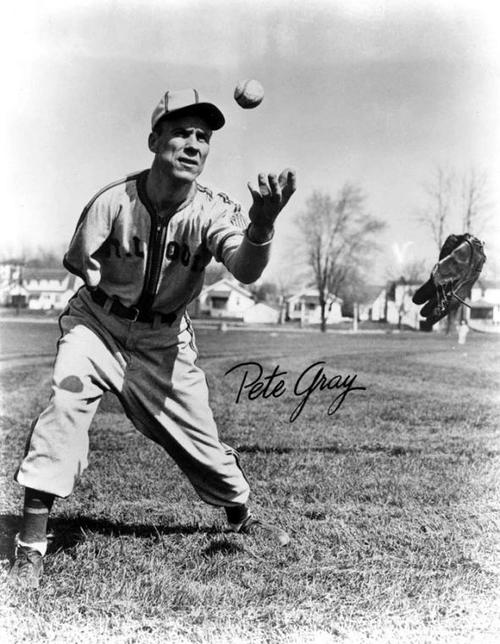
Pete Gray, The "One-Armed Wonder"

When the nation was put on a war footing after the Japanese Empire attacked Pearl Harbor, President Franklin Roosevelt decreed that professional baseball continue as a home front morale booster. Obviously the quality of the product would change due to manpower shortages, and MLB's 16 teams were stocked with older veterans, kids, men who had been classified 4-F (not fit for service), and other players who for one reason or another could not join the fight in Europe or Asia, but who could still swing a baseball bat. It was a situation, for example, in which a 15-year old by the name of Joe Nuxhall could find himself going from a high school mound to suddenly wearing a Reds uniform and staring down Stan Musial. (After leaving Cincinnati with a 67.0 ERA, Nuxhall returned to the Reds in 1952 and pitched for them for 15 seasons,and then became a beloved Reds broadcaster after his playing days).

It was also a situation in which a one-armed man wound up in the outfield of the St. Louis Browns. The brief black and white footage of Pete Gray in his Browns uniform always was conflated in my mind with the image of the midget Eddie Gaedel, who had one at-bat with the Browns in 1951: symbols of Browns ineptitude and desperation, publicity stunts, freak shows. (Side note about Gaedel: After the American League president voided Gaedel's contract, Brown's owner Bill Veeck demanded a ruling on whether Yankees shortstop Phil Rizzuto was a "short man or a tall midget", but we'll deal with Veeck another day.)

However the story of Pete Gray is much more complicated and interesting, as Gray was quite a ballplayer. Pete Wyshner was born on March 6, 1915 in Nanticoke, in the anthracite coal filed region of northern Pennsylvania. Six-year-old Petey lost his right arm when he was thrown from a truck and it had to be amputated above the elbow. The boy was right handed, so it took fierce determination on his part to learn how to use his left arm to bat and field, a determination that eventually led all the way to the big leagues.


Having exhausted his prospects in the local anthracite leagues, Wyshner (having changed his name to Gray to appear less "ethnic") set out for New York, where he impressed Max Rosner, owner of the Brooklyn Bushwicks. The Bushwicks were one of the top semi-pro teams in the country and faced talented opposition, including the best teams in the Negro leagues. Gray was a crowd pleaser from the beginning, and his baseball abilities attracted the attention of a scout for Trois Rivieres of the Canadian-American League. The scout had failed to mention that Gray had only one arm, and when Pete first met the Foxes manager he was, to say the least, quite surprised at his new prospect.

In the outfield, Gray developed a technique by which he could transfer the ball from his glove back to his hand and throw to the infield almost as fast as a two-armed player. It involved catching the ball, then quickly tucking his glove under the stump of his right arm while rolling the ball across his chest and into his hand. He did this so effortlessly he seemed to achieve these maneuvers in one smooth motion. At the plate Gray was an effective bunter and despite having only one arm, he managed to have very quick bat speed, although his power was limited for obvious reasons. His good eyes meant that he did not often strike out, and he was an aggressive and speedy baserunner.

Pete Gray's fielding technique

After an impressive season with Trois Rivieres, Gray's contract was purchased by the Toronto Maple Leafs of the International League, one step away from the majors. However after making the first cut, he was released by Toronto. (One account has it that an insult about manager Burleigh Grimes got back to the manager and that Gray was cut in retribution). After contacting over a dozen teams and coming up empty, he was finally given a shot by veteran manager Doc Prothro of the Memphis Chicks. Gray performed admirably for Memphis in 1943, batting .289 with 231 hits and 42 RBI. He distinguished himself with the gritty style of play which he had learned back in the Pennsylvania coal leagues. Gray also inspired servicemen fighting overseas, many of whom had returned home with missing or amputated limbs. He often visited recovering servicemen, and his exploits were documented in newsreels which were shown all over the country. The Memphis club invited a young boy named Nelson Gary who had also lost his arm to meet his hero and watch Gray play, and in a performance worthy of the legends associated with Babe Ruth, Pete responded by hitting two singles, a double, and a triple during the game.

But it was in 1944 that Gray peaked as a ballplayer. He hit all five of his career home runs during the '44 campaign, and his .333 average, 60 RBI and 68 stolen records (tied for the league record) were enough for him to be voted Southern Association MVP for 1944. His accomplishments did not stop at his offensive exploits, as he boasted an incredible .996 fielding percentage as well. I mention these statistics because it is important to note that despite the manpower depletion caused by the war, Pete Gray earned his promotion to the majors due to his achievements on the baseball diamond. Gray was also enormously popular with Memphis fans.

The usually lowly St. Louis Browns had seen their fortunes change in 1944 when they won the American league pennant and faced off against their intracity rivals the Cardinals in the World Series. Although the two teams shared a stadium - Sportsman's Park - that's about all they had in common, and it was usually the Redbirds who had the upper hand in the standings, as well as the box office. Led by crafty manager Luke Sewell, the Browns pitching and defense was just good enough to capture the pennant despite a .252 team batting average and no fewer than 13 players with a military 4-F classification, the most of any team in the majors. But despite the Brown's change of fortunes on the field, the club still was in a precarious financial state, and there is no doubt that owner Donald Barnes saw Gray as not just a ballplayer, but as a gate attraction, an idea that was anathema to Pete Gray, who wanted to make it purely on his skills.

Gray singled in his first major league game, against the Detroit Tigers, but then went into a slump and was removed from the starting lineup. He soon returned to form, however, and began to see more playing time. Pete was so popular with St. Louis fans that many would call the Browns' box office the day of a game to see whether he would be in the lineup before deciding to head to the park.

At left, Pete Gray's St. Louis Browns cap.

Browns' manager Luke Sewell had a dilemma. Because of Gray's popularity with fans both at home and on the road there was pressure to play him. The Browns fell behind the pace early in the season, and it was Sewell's job to win ballgames, not please fans, so although he treated Gray fairly he gave him less and less playing time as the season wore on.

Events conspired on and off the field to ensure that 1945 would be Pete Gray's only season in the majors. Pitchers soon found out that without a right arm, Gray could not check his swing or adjust very well to curve balls, so rather than trying to overpower him with fastballs, Gray was fed a steady diet of breaking pitches. Outfielders, knowing his lack of power, would play him in. Runners were able to exploit the small amount of extra time it took Gray to deliver the ball to the infield and would routinely take the extra base. VJ day meant the end of the war, and the beginning of the return of major leaguers to their rosters. When Donald Barnes sold his interest in the Browns in August, Gray no longer had a champion in the front office. Pete Gray finished the 1945 season with a disappointing .218 average and 13 RBI in 77 games. He managed to steal only five bases.


Pete's relationships with his teammates were also complicated. A few grumbled (unfairly) that he cost them a chance to repeat for the pennant because management chose to play him as a gate draw rather than a more able player. Outfielder Mike Kreevich, who had hit .301 the previous season, resented having to platoon with him. Gray, like many ballplayers of the time, was also a heavy drinker, and any tension with his fellow players could not have been helped by his alcohol intake.


The Browns organized a West Coast barnstorming trip for Pete after the season, and even arranged for him to appear in a Hollywood movie, playing himself. But when he learned he would only be paid $15,000 for his services and would have to wear a hairpiece, he nixed the idea.

Pete Gray in a Memphis Chicks uniform.

After being released by the Browns, Gray was offered a contract by the Toledo Mud Hens but almost lost his eligibility when he held out for the first month of the season. He was suspended in 1947 for failing to report, but came back and hit .290 for Elmira in '48. Pete Gray ended his professional baseball career with the Dallas Eagles of the Texas League in 1949, then returned to his hometown of Nanticoke where he lived quietly, avoiding the limelight and most interview requests, until his death in 2002.

Our Flannel Of The Month is of course Pete Gray's 1944 home Memphis Chicks jersey. It has the war-era "Health" patch on the right sleeve and Indian head patch on the left. The back is adorned with Pete Gray's #3.

Thursday, June 16, 2011

What's In A Name? Baseball Team Names Throughout History

Every so often someone not terribly familiar with what we do walks into the showroom and breaks into a snicker upon encountering an Atlanta Crackers jersey. "Was there really a team called that?", they invariably ask. Without missing a beat, we always say "not only was there an Atlanta Crackers, there was an Atlanta Black Crackers", at which point the snicker usually turns into a guffaw.

It may seem odd for a Negro league team to call itself the "Black Crackers" but they were simply following a common practice of adapting the major or minor league team name from the same city.

This brings us to the subject of this month's blog, which is team names. In contemporary times, tens of thousands are spent by teams on consultants, focus groups and "branding" companies to develop team "identity", which often includes a new nickname. Professional baseball at all levels is a big business today, and these things are not left to chance. Although a few clubs have hung on to their traditional identities (thank you, Rochester Red Wings, Durham Bulls and Buffalo Bisons), the trend of the past two decades has leaned toward lots of cutesy animal logos and names like SeaDogs, River Cats, Hillcats, Warthogs - you get the picture. Good or bad, nicknames today are another part of the corporate branding process. One can also argue that the contrived and trendy names many minor league clubs have adopted are at least unique and preferable to the trend of the 1960s through 1980s, which was simply to adopt the parent major league club's nickname.

It was not always thus. In the beginning (the 19th century) professional baseball teams rarely had formal nicknames. Nicknames evolved when reporters, headline writers, and fans needed a shorter and more affectionate way to refer to the local nine, so team nicknames gradually developed organically. One common way to refer to a ballclub was by the color scheme on their uniforms, so we got "Red Stockings", "White Stockings", "Browns", etc. These have evolved into some of the team names that are still with us in the majors today. Another approach was to use the league name as shorthand for the team, as in "Philadelphia Americans" as an alternative for "Athletics". Baseball cards were often marked this way, "Detroit Americans" or "Pittsburgh Nationals". (This system was slightly confused by the American League Washington club taking the name "Nationals" for a time.) Or teams were simply referred to by a plural of their city name, as in "the Brooklyns". Sometimes, a simple geographic feature could spark a nickname, as was the case for the New York Highlanders, who played at Hilltop Park (who we know know as the Yankees). The important point here is that for several decades team nicknames were unofficial and and rather elastic. Most fans know the Dodgers tried on "Bridegrooms", "Superbas" and "Robins" before settling on Dodgers, and Boston's National League club was known as the "Beaneaters" and the "Bees" before they were the Braves. It took time for clubs to develop traditions and histories which were the foundation needed to give life to names that stuck. In the rare case that club owners tried to force a new nickname on fans it was not always successful, as when Philadelphia's National league club announced in 1945 that they would henceforth be named the "Bluejays". The new name didn't stick (perhaps the fact that the team neglected to take "Phillies" off the uniform didn't help).

When the Federal League came on the scene to challenge the majors in 1914, the lack of acknowledged nicknames created an identity problem for the fledgling circuit, and baseball writers struggled to come up with names that reflected the new league's name, so we ended up with the rather awkward "Brookfeds", "Buffeds" and "Chifeds". When Indianapolis' "Hoosierfeds" moved to Newark for the 1915 season, writers dubbed them the "Newfeds" (Fortunately sanity prevailed, and the alternative "Peppers" or "Peps" seems to have won out). It was not until the second and final Federal League season that "Tip-Tops" stuck for Brooklyn, "Whales" for Chicago, etc.

Getting back to the minor leagues, hundreds of cities and towns meant hundreds of names. When you read through some of the league standings over the years, you cannot help but crack a smile at the ingenuity, humor and pure fun of many of these team names (or be puzzled by some of the odder or more archaic ones). I thought I would go over some of them, and I have divided them into several categories for your reading pleasure. One could form entire leagues just based on the nickname type:

Alliteration Division: Some names just roll off the tongue. We have the Lincoln Links, Hopkinsville Hoppers, Goldboro Goldbugs, Terre Haute Terriers, and Sioux City Soos, Palestine Pals, and Crookston Crooks. This category would not be complete, of course, without the Hannibal Cannibals, who took the Illinois-Missouri League title in 1908.


Your 1934 Lincoln Links.

Industrial Division: It was common for ballclubs to acquire a nickname related to a local industry, so we got the Brockton Shoemakers, Gloversville Glovers, Bassett Furnitute Makers, Tulsa Oilers, and all manner of Fruit Pickers, Raisin Eaters and Manufacturers. However, the Findlay Natural Gassers of the Inter-State League must have been relieved when their name was changed to Oilers.

Institutional Division: Nearby institutions led to the Joliet Convicts, Leavenworth Convicts, Auburn Prisoners, Utica Asylums, and Nevada (MO) Lunatics.

International and Ethnic Division features the Paris Parisians, Dublin Irish, London Cockneys, Rome Romans, Troy Trojans, Cairo Egyptians, Shreveport Creoles, Baton Rouge Cajuns, Edmonton Eskimos, Coronado Arabs, Shenandoah Hungarian Rioters, and, we regret to mention, the Canton Chinks of the Illinois-Missouri League. To make matters worse, Canon City, Colorado's Rocky Mountain League club was called the Swastikas, and their uniform featured the symbol on the jersey sleeve, but this was 1912 - many years before the swastika was adopted by the Nazis.

Edmonton Eskimos, Western Canada League champs, 1955

Religion anyone? We bring you the Battle Creek Adventists, St. Paul Saints, Selma Christians, Enid Evangelists, Natchez Pilgrims, Palmyra Mormons, Salt Lake City Elders, Battle Creek Adventists, and Charlotte Presbyterians.

We've done religion, now how about politics? In addition to the dozens of teams named "Senators", we also have the Marion Presidents, Guthrie Legislators, Albany Governors, and Topeka Populists. The Decatur Commies played during the McCarthy era, and was beer available in the ballpark when the Des Moines Prohibitionists took the field? One wonders.

Historical Division
: Paris Bourbonites of Kentucky played in the Blue Grass League, and it really must have been a battle when the York White Roses faced the Lancaster Red Roses in Inter-State League action.

The 1950 Hopkinsville KITTY League club had a dual nickname, as they were known as the Hoptown Hoppers.

Criminality Division: Omaha Kidnappers, Asheville Moonshiners, Lowell Highwaymen, and Corsicana Desperadoes.

Teams we feel sorry for: It's doubtful the Kirksville Osteopaths struck fear into the hearts of their opponents, and pity the poor player who had to listen to the taunts of enemy fans as a member of the San Jose Florists, Hopewell Powderpuffs, or Salem Fairies.

We could form an NFL division from these teams: Bears (Mobile), Packers (Dubuque), Lions (Lodi), Patriots (Gettysburg), Seahawks (Port Arthur), Cowboys (Tucson), Colts (Orlando), Raiders (Cedar Rapids), Bengals (Columbus), Eagles (Dallas), Browns (Valdosta), and Jets (Ponca City).

In the Oxymoron Division the Columbus (GA) Confederate Yankees must have been very confused, as were the above-mentioned Atlanta Black Crackers.

There was all manner of royalty in the minors: The Bisbee-Douglas Copper Kings toiled in southeastern Arizona. The Ottumwa Coal Palace Kings took the Illinois-Iowa league crown in 1890. The Brenham Kaisers fittingly played during World War I in 1914-15, at least before the Middle Texas League folded.

Long before the Washington Senators moved to Minnesota, it was common for teams shared by two cities to be called "Twins", as in Fargo-Morehead (ND-MN), Dunn-Erwin (NC), and Sherman-Denison (TX). Leakesville-Spray-Draper, NC was of course the "Triplets". But Johnstown-Amsterdam-Gloverville, NY addressed this same challenge by calling themselves the "Hyphens".

Lastly, there are historic team names we just love that don't fit into any category: The Lima Bean Eaters, Zanesville Flood Sufferers, Memphis Fever Germs, Kearney Kapitalists, and Regina Bonepilers, to name just a few.

Our Flannel Of The Month for June has nothing to do with the subject matter of the blog, but it's a beauty nonetheless: Tony Lazzeri's 1925 Salt Lake Bees home jersey, with a glorious bee manually embroidered on the chest. Available for $129 for a limited time.