Perhaps the only thing I like in baseball as much as historical uniforms is old ballparks. Sadly, I never got to see a game at Ebbets Field, the Polo Grounds, Tiger Stadium, or Forbes Field. We only have two of these gems left, and the good citizens of Boston and Chicago are lucky indeed to still have Fenway Park and Wrigley Field.
Weeghman Park, as it looked in 1914.
The first time I visited Wrigley was in the late 1980s. I had just started the Ebbets Field Flannels, and was full of idealism and a renewed love for the game. I had already been to a Sox game at old Comiskey on this trip. The Cubs were out of town, but it was a glorious summer day, and I decided to head to the North Side anyway and have a look. After walking from the Addison L station, I stood on the sidewalk on Clark Street greedily eying the entrance. The wisp of green that lay a fleeting few steps away beckoned me. A maintenance worker was spraying the ground with a hose, and when he turned his back to me I made one of those instant decisions and slipped in behind him. I quickly made my way up the ramp into the stands and walked down the right field side looking over my shoulder, as I expected to be ejected at any moment. But no one said a word. There was just the beautiful summer day, the row upon row of empty seats, the towering hand-operated scoreboard above the bleachers, and the dazzling emrald green of the outfield. It was strangely quite and peaceful, with the only sounds being the sprinklers and the distant sounds of the neighborhood. I didn't push my luck by going down to the field, but with the park all to myself I just sat back and enjoyed the moment, then quietly left the same way I came in.
One of the most legendary - and controversial - moments in baseball history. Babe Ruth calls his shot in the 1932 World Series at Wrigley Field...or does he?
A recent trip to Chicago found me with some time on my hands. Again, the Cubs were out of town, and having no interest in the South Side team since they tore down old Comiskey I decided I'd be "legit" this time and take the Wrigley tour. If you are a baseball history buff like I am, it's the best 25 bucks you'll ever spend. The tour guides are informative and entertaining and you get to go into a lot of nooks and crannies of this lovely old park, including the clubhouses and press box (but alas, not the manual scoreboard in center field).
Left: The Whales won the 1915 Federal League crown behind the pitching of Mordecai "Three Finger" Brown. This photo of Brown's disfigured right hand was taken at Weeghman Park.
A few fun facts, EFFers might already know: Wrigley Field started out as Weeghman Park, and was built not for the Cubbies, but for the Chicago franchise of the fledgling Federal League. Chi-Feds owner Charles Weeghman wanted to best both the Cubs and the Sox, and built the most modern facility in baseball at that time in just five weeks. The park at that time featured only the main seating bowl - no upper deck or bleachers. Also, the Cubs must have brought their own bad luck when they moved into the park later, as Weeghman saw a championship in only its second season, as the Feds (now christened the Whales) won the pennant in the Federal League's final campaign of 1915. When the league passed into history after the 1915 season, Weeghman put together a syndicate to buy the Cubs, and the National Leaguers moved into the park in 1916. It was renamed Cubs Park in 1920, and finally Wrigley Field in 1927, after the chewing gum magnate had gained control of the team.
1927 also saw the upper deck completed, and the current bleachers and scoreboard were added in 1937 by Bill Veeck, who also planted the famous ivy (amazing how often Veeck's name pops up in these stories). As we all know, lights were not installed until 1988 - the last major league park to do so.
The NFL Bears were accommodated with an extra bleacher section that held 9,000.
What struck me most about the contrast of Wrigley Field today with my first visit was not in the park itself, but across the street on Waveland and Sheffield Avenues. The apartment buildings that literally look into Wrigley always had lucky tenants who could watch the game from the rooftops. But by the early 1990s, this evolved into a full-fledged commercial operation. The tenants have been cleared from most of these buildings, and professional stadium seating (sometimes double-decked) has been installed. These seats are sold through ticket brokers, just like the seats inside the park. While it is hard to deny the role revenue plays in every aspect of major league baseball these days, this phenomenon seems not really keeping in the old neighborhood spirit of the thing. (Rather than put up a "spite" fence, the Cubs made a deal with these operators and take 17% off the top).
Wrigley, of course, has not meant just baseball. The Chicago Bears called it home until 1970. (A Northwestern University college football game was played in Wrigley last season but seats added since the Bears left meant that all offensive plays had to be run in one direction!). The NHL played its Winter Classic here in 2009.
Wrigley Field today, from the press box.
There are very few places left in the world where I can truly feel like a kid, and Wrigley is one of them. To sit in the bleachers and bask in the sun under that magnificent scoreboard while the timeless sights, sounds, and rhythms of baseball seep into your pores along with the sunshine is one of life's remaining simple pleasures. As Harry Caray might say: "Holy Cow!".
Our Flannel Of The Month is the 1915 Federal League champion Chicago Whales home jersey. The team was known as the Chifeds or simply Federals its first season, but a fan naming contest was held in 1915 and "Whales" was the second most popular entry. The top vote-getter? Chickens!.
"Every Club shall adopt uniforms for its players, and the suits of each team shall conform in color and style".
Monday, August 29, 2011
Thursday, July 21, 2011
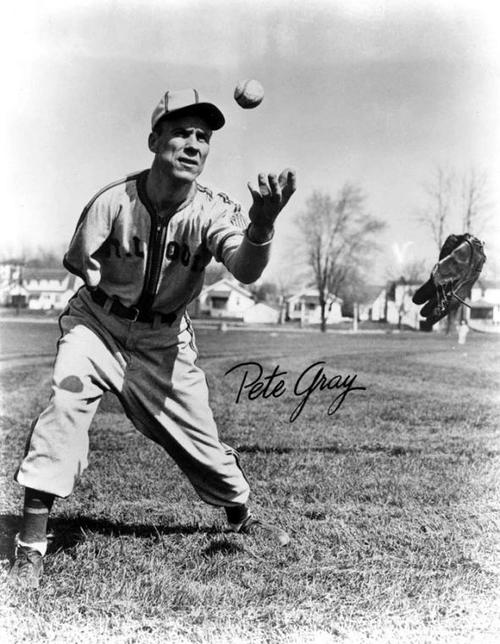
Pete Gray, The "One-Armed Wonder"
When the nation was put on a war footing after the Japanese Empire attacked Pearl Harbor, President Franklin Roosevelt decreed that professional baseball continue as a home front morale booster. Obviously the quality of the product would change due to manpower shortages, and MLB's 16 teams were stocked with older veterans, kids, men who had been classified 4-F (not fit for service), and other players who for one reason or another could not join the fight in Europe or Asia, but who could still swing a baseball bat. It was a situation, for example, in which a 15-year old by the name of Joe Nuxhall could find himself going from a high school mound to suddenly wearing a Reds uniform and staring down Stan Musial. (After leaving Cincinnati with a 67.0 ERA, Nuxhall returned to the Reds in 1952 and pitched for them for 15 seasons,and then became a beloved Reds broadcaster after his playing days).
It was also a situation in which a one-armed man wound up in the outfield of the St. Louis Browns. The brief black and white footage of Pete Gray in his Browns uniform always was conflated in my mind with the image of the midget Eddie Gaedel, who had one at-bat with the Browns in 1951: symbols of Browns ineptitude and desperation, publicity stunts, freak shows. (Side note about Gaedel: After the American League president voided Gaedel's contract, Brown's owner Bill Veeck demanded a ruling on whether Yankees shortstop Phil Rizzuto was a "short man or a tall midget", but we'll deal with Veeck another day.)
However the story of Pete Gray is much more complicated and interesting, as Gray was quite a ballplayer. Pete Wyshner was born on March 6, 1915 in Nanticoke, in the anthracite coal filed region of northern Pennsylvania. Six-year-old Petey lost his right arm when he was thrown from a truck and it had to be amputated above the elbow. The boy was right handed, so it took fierce determination on his part to learn how to use his left arm to bat and field, a determination that eventually led all the way to the big leagues.
Having exhausted his prospects in the local anthracite leagues, Wyshner (having changed his name to Gray to appear less "ethnic") set out for New York, where he impressed Max Rosner, owner of the Brooklyn Bushwicks. The Bushwicks were one of the top semi-pro teams in the country and faced talented opposition, including the best teams in the Negro leagues. Gray was a crowd pleaser from the beginning, and his baseball abilities attracted the attention of a scout for Trois Rivieres of the Canadian-American League. The scout had failed to mention that Gray had only one arm, and when Pete first met the Foxes manager he was, to say the least, quite surprised at his new prospect.
In the outfield, Gray developed a technique by which he could transfer the ball from his glove back to his hand and throw to the infield almost as fast as a two-armed player. It involved catching the ball, then quickly tucking his glove under the stump of his right arm while rolling the ball across his chest and into his hand. He did this so effortlessly he seemed to achieve these maneuvers in one smooth motion. At the plate Gray was an effective bunter and despite having only one arm, he managed to have very quick bat speed, although his power was limited for obvious reasons. His good eyes meant that he did not often strike out, and he was an aggressive and speedy baserunner.
Pete Gray's fielding technique
After an impressive season with Trois Rivieres, Gray's contract was purchased by the Toronto Maple Leafs of the International League, one step away from the majors. However after making the first cut, he was released by Toronto. (One account has it that an insult about manager Burleigh Grimes got back to the manager and that Gray was cut in retribution). After contacting over a dozen teams and coming up empty, he was finally given a shot by veteran manager Doc Prothro of the Memphis Chicks. Gray performed admirably for Memphis in 1943, batting .289 with 231 hits and 42 RBI. He distinguished himself with the gritty style of play which he had learned back in the Pennsylvania coal leagues. Gray also inspired servicemen fighting overseas, many of whom had returned home with missing or amputated limbs. He often visited recovering servicemen, and his exploits were documented in newsreels which were shown all over the country. The Memphis club invited a young boy named Nelson Gary who had also lost his arm to meet his hero and watch Gray play, and in a performance worthy of the legends associated with Babe Ruth, Pete responded by hitting two singles, a double, and a triple during the game.
But it was in 1944 that Gray peaked as a ballplayer. He hit all five of his career home runs during the '44 campaign, and his .333 average, 60 RBI and 68 stolen records (tied for the league record) were enough for him to be voted Southern Association MVP for 1944. His accomplishments did not stop at his offensive exploits, as he boasted an incredible .996 fielding percentage as well. I mention these statistics because it is important to note that despite the manpower depletion caused by the war, Pete Gray earned his promotion to the majors due to his achievements on the baseball diamond. Gray was also enormously popular with Memphis fans.
The usually lowly St. Louis Browns had seen their fortunes change in 1944 when they won the American league pennant and faced off against their intracity rivals the Cardinals in the World Series. Although the two teams shared a stadium - Sportsman's Park - that's about all they had in common, and it was usually the Redbirds who had the upper hand in the standings, as well as the box office. Led by crafty manager Luke Sewell, the Browns pitching and defense was just good enough to capture the pennant despite a .252 team batting average and no fewer than 13 players with a military 4-F classification, the most of any team in the majors. But despite the Brown's change of fortunes on the field, the club still was in a precarious financial state, and there is no doubt that owner Donald Barnes saw Gray as not just a ballplayer, but as a gate attraction, an idea that was anathema to Pete Gray, who wanted to make it purely on his skills.
Gray singled in his first major league game, against the Detroit Tigers, but then went into a slump and was removed from the starting lineup. He soon returned to form, however, and began to see more playing time. Pete was so popular with St. Louis fans that many would call the Browns' box office the day of a game to see whether he would be in the lineup before deciding to head to the park.
At left, Pete Gray's St. Louis Browns cap.
Browns' manager Luke Sewell had a dilemma. Because of Gray's popularity with fans both at home and on the road there was pressure to play him. The Browns fell behind the pace early in the season, and it was Sewell's job to win ballgames, not please fans, so although he treated Gray fairly he gave him less and less playing time as the season wore on.
Events conspired on and off the field to ensure that 1945 would be Pete Gray's only season in the majors. Pitchers soon found out that without a right arm, Gray could not check his swing or adjust very well to curve balls, so rather than trying to overpower him with fastballs, Gray was fed a steady diet of breaking pitches. Outfielders, knowing his lack of power, would play him in. Runners were able to exploit the small amount of extra time it took Gray to deliver the ball to the infield and would routinely take the extra base. VJ day meant the end of the war, and the beginning of the return of major leaguers to their rosters. When Donald Barnes sold his interest in the Browns in August, Gray no longer had a champion in the front office. Pete Gray finished the 1945 season with a disappointing .218 average and 13 RBI in 77 games. He managed to steal only five bases.
Pete's relationships with his teammates were also complicated. A few grumbled (unfairly) that he cost them a chance to repeat for the pennant because management chose to play him as a gate draw rather than a more able player. Outfielder Mike Kreevich, who had hit .301 the previous season, resented having to platoon with him. Gray, like many ballplayers of the time, was also a heavy drinker, and any tension with his fellow players could not have been helped by his alcohol intake.
The Browns organized a West Coast barnstorming trip for Pete after the season, and even arranged for him to appear in a Hollywood movie, playing himself. But when he learned he would only be paid $15,000 for his services and would have to wear a hairpiece, he nixed the idea.
Pete Gray in a Memphis Chicks uniform.
After being released by the Browns, Gray was offered a contract by the Toledo Mud Hens but almost lost his eligibility when he held out for the first month of the season. He was suspended in 1947 for failing to report, but came back and hit .290 for Elmira in '48. Pete Gray ended his professional baseball career with the Dallas Eagles of the Texas League in 1949, then returned to his hometown of Nanticoke where he lived quietly, avoiding the limelight and most interview requests, until his death in 2002.
Our Flannel Of The Month is of course Pete Gray's 1944 home Memphis Chicks jersey. It has the war-era "Health" patch on the right sleeve and Indian head patch on the left. The back is adorned with Pete Gray's #3.
It was also a situation in which a one-armed man wound up in the outfield of the St. Louis Browns. The brief black and white footage of Pete Gray in his Browns uniform always was conflated in my mind with the image of the midget Eddie Gaedel, who had one at-bat with the Browns in 1951: symbols of Browns ineptitude and desperation, publicity stunts, freak shows. (Side note about Gaedel: After the American League president voided Gaedel's contract, Brown's owner Bill Veeck demanded a ruling on whether Yankees shortstop Phil Rizzuto was a "short man or a tall midget", but we'll deal with Veeck another day.)
However the story of Pete Gray is much more complicated and interesting, as Gray was quite a ballplayer. Pete Wyshner was born on March 6, 1915 in Nanticoke, in the anthracite coal filed region of northern Pennsylvania. Six-year-old Petey lost his right arm when he was thrown from a truck and it had to be amputated above the elbow. The boy was right handed, so it took fierce determination on his part to learn how to use his left arm to bat and field, a determination that eventually led all the way to the big leagues.
Having exhausted his prospects in the local anthracite leagues, Wyshner (having changed his name to Gray to appear less "ethnic") set out for New York, where he impressed Max Rosner, owner of the Brooklyn Bushwicks. The Bushwicks were one of the top semi-pro teams in the country and faced talented opposition, including the best teams in the Negro leagues. Gray was a crowd pleaser from the beginning, and his baseball abilities attracted the attention of a scout for Trois Rivieres of the Canadian-American League. The scout had failed to mention that Gray had only one arm, and when Pete first met the Foxes manager he was, to say the least, quite surprised at his new prospect.
In the outfield, Gray developed a technique by which he could transfer the ball from his glove back to his hand and throw to the infield almost as fast as a two-armed player. It involved catching the ball, then quickly tucking his glove under the stump of his right arm while rolling the ball across his chest and into his hand. He did this so effortlessly he seemed to achieve these maneuvers in one smooth motion. At the plate Gray was an effective bunter and despite having only one arm, he managed to have very quick bat speed, although his power was limited for obvious reasons. His good eyes meant that he did not often strike out, and he was an aggressive and speedy baserunner.
Pete Gray's fielding technique
After an impressive season with Trois Rivieres, Gray's contract was purchased by the Toronto Maple Leafs of the International League, one step away from the majors. However after making the first cut, he was released by Toronto. (One account has it that an insult about manager Burleigh Grimes got back to the manager and that Gray was cut in retribution). After contacting over a dozen teams and coming up empty, he was finally given a shot by veteran manager Doc Prothro of the Memphis Chicks. Gray performed admirably for Memphis in 1943, batting .289 with 231 hits and 42 RBI. He distinguished himself with the gritty style of play which he had learned back in the Pennsylvania coal leagues. Gray also inspired servicemen fighting overseas, many of whom had returned home with missing or amputated limbs. He often visited recovering servicemen, and his exploits were documented in newsreels which were shown all over the country. The Memphis club invited a young boy named Nelson Gary who had also lost his arm to meet his hero and watch Gray play, and in a performance worthy of the legends associated with Babe Ruth, Pete responded by hitting two singles, a double, and a triple during the game.
But it was in 1944 that Gray peaked as a ballplayer. He hit all five of his career home runs during the '44 campaign, and his .333 average, 60 RBI and 68 stolen records (tied for the league record) were enough for him to be voted Southern Association MVP for 1944. His accomplishments did not stop at his offensive exploits, as he boasted an incredible .996 fielding percentage as well. I mention these statistics because it is important to note that despite the manpower depletion caused by the war, Pete Gray earned his promotion to the majors due to his achievements on the baseball diamond. Gray was also enormously popular with Memphis fans.
The usually lowly St. Louis Browns had seen their fortunes change in 1944 when they won the American league pennant and faced off against their intracity rivals the Cardinals in the World Series. Although the two teams shared a stadium - Sportsman's Park - that's about all they had in common, and it was usually the Redbirds who had the upper hand in the standings, as well as the box office. Led by crafty manager Luke Sewell, the Browns pitching and defense was just good enough to capture the pennant despite a .252 team batting average and no fewer than 13 players with a military 4-F classification, the most of any team in the majors. But despite the Brown's change of fortunes on the field, the club still was in a precarious financial state, and there is no doubt that owner Donald Barnes saw Gray as not just a ballplayer, but as a gate attraction, an idea that was anathema to Pete Gray, who wanted to make it purely on his skills.
Gray singled in his first major league game, against the Detroit Tigers, but then went into a slump and was removed from the starting lineup. He soon returned to form, however, and began to see more playing time. Pete was so popular with St. Louis fans that many would call the Browns' box office the day of a game to see whether he would be in the lineup before deciding to head to the park.
At left, Pete Gray's St. Louis Browns cap.
Browns' manager Luke Sewell had a dilemma. Because of Gray's popularity with fans both at home and on the road there was pressure to play him. The Browns fell behind the pace early in the season, and it was Sewell's job to win ballgames, not please fans, so although he treated Gray fairly he gave him less and less playing time as the season wore on.
Events conspired on and off the field to ensure that 1945 would be Pete Gray's only season in the majors. Pitchers soon found out that without a right arm, Gray could not check his swing or adjust very well to curve balls, so rather than trying to overpower him with fastballs, Gray was fed a steady diet of breaking pitches. Outfielders, knowing his lack of power, would play him in. Runners were able to exploit the small amount of extra time it took Gray to deliver the ball to the infield and would routinely take the extra base. VJ day meant the end of the war, and the beginning of the return of major leaguers to their rosters. When Donald Barnes sold his interest in the Browns in August, Gray no longer had a champion in the front office. Pete Gray finished the 1945 season with a disappointing .218 average and 13 RBI in 77 games. He managed to steal only five bases.
Pete's relationships with his teammates were also complicated. A few grumbled (unfairly) that he cost them a chance to repeat for the pennant because management chose to play him as a gate draw rather than a more able player. Outfielder Mike Kreevich, who had hit .301 the previous season, resented having to platoon with him. Gray, like many ballplayers of the time, was also a heavy drinker, and any tension with his fellow players could not have been helped by his alcohol intake.
The Browns organized a West Coast barnstorming trip for Pete after the season, and even arranged for him to appear in a Hollywood movie, playing himself. But when he learned he would only be paid $15,000 for his services and would have to wear a hairpiece, he nixed the idea.
Pete Gray in a Memphis Chicks uniform.
After being released by the Browns, Gray was offered a contract by the Toledo Mud Hens but almost lost his eligibility when he held out for the first month of the season. He was suspended in 1947 for failing to report, but came back and hit .290 for Elmira in '48. Pete Gray ended his professional baseball career with the Dallas Eagles of the Texas League in 1949, then returned to his hometown of Nanticoke where he lived quietly, avoiding the limelight and most interview requests, until his death in 2002.
Our Flannel Of The Month is of course Pete Gray's 1944 home Memphis Chicks jersey. It has the war-era "Health" patch on the right sleeve and Indian head patch on the left. The back is adorned with Pete Gray's #3.
Labels:
Memphis Chicks,
Pete Gray,
St. Louis Browns,
Wartime Baseball
Thursday, June 16, 2011
What's In A Name? Baseball Team Names Throughout History
Every so often someone not terribly familiar with what we do walks into the showroom and breaks into a snicker upon encountering an Atlanta Crackers jersey. "Was there really a team called that?", they invariably ask. Without missing a beat, we always say "not only was there an Atlanta Crackers, there was an Atlanta Black Crackers", at which point the snicker usually turns into a guffaw.
It may seem odd for a Negro league team to call itself the "Black Crackers" but they were simply following a common practice of adapting the major or minor league team name from the same city.
This brings us to the subject of this month's blog, which is team names. In contemporary times, tens of thousands are spent by teams on consultants, focus groups and "branding" companies to develop team "identity", which often includes a new nickname. Professional baseball at all levels is a big business today, and these things are not left to chance. Although a few clubs have hung on to their traditional identities (thank you, Rochester Red Wings, Durham Bulls and Buffalo Bisons), the trend of the past two decades has leaned toward lots of cutesy animal logos and names like SeaDogs, River Cats, Hillcats, Warthogs - you get the picture. Good or bad, nicknames today are another part of the corporate branding process. One can also argue that the contrived and trendy names many minor league clubs have adopted are at least unique and preferable to the trend of the 1960s through 1980s, which was simply to adopt the parent major league club's nickname.
It was not always thus. In the beginning (the 19th century) professional baseball teams rarely had formal nicknames. Nicknames evolved when reporters, headline writers, and fans needed a shorter and more affectionate way to refer to the local nine, so team nicknames gradually developed organically. One common way to refer to a ballclub was by the color scheme on their uniforms, so we got "Red Stockings", "White Stockings", "Browns", etc. These have evolved into some of the team names that are still with us in the majors today. Another approach was to use the league name as shorthand for the team, as in "Philadelphia Americans" as an alternative for "Athletics". Baseball cards were often marked this way, "Detroit Americans" or "Pittsburgh Nationals". (This system was slightly confused by the American League Washington club taking the name "Nationals" for a time.) Or teams were simply referred to by a plural of their city name, as in "the Brooklyns". Sometimes, a simple geographic feature could spark a nickname, as was the case for the New York Highlanders, who played at Hilltop Park (who we know know as the Yankees). The important point here is that for several decades team nicknames were unofficial and and rather elastic. Most fans know the Dodgers tried on "Bridegrooms", "Superbas" and "Robins" before settling on Dodgers, and Boston's National League club was known as the "Beaneaters" and the "Bees" before they were the Braves. It took time for clubs to develop traditions and histories which were the foundation needed to give life to names that stuck. In the rare case that club owners tried to force a new nickname on fans it was not always successful, as when Philadelphia's National league club announced in 1945 that they would henceforth be named the "Bluejays". The new name didn't stick (perhaps the fact that the team neglected to take "Phillies" off the uniform didn't help).
When the Federal League came on the scene to challenge the majors in 1914, the lack of acknowledged nicknames created an identity problem for the fledgling circuit, and baseball writers struggled to come up with names that reflected the new league's name, so we ended up with the rather awkward "Brookfeds", "Buffeds" and "Chifeds". When Indianapolis' "Hoosierfeds" moved to Newark for the 1915 season, writers dubbed them the "Newfeds" (Fortunately sanity prevailed, and the alternative "Peppers" or "Peps" seems to have won out). It was not until the second and final Federal League season that "Tip-Tops" stuck for Brooklyn, "Whales" for Chicago, etc.
Getting back to the minor leagues, hundreds of cities and towns meant hundreds of names. When you read through some of the league standings over the years, you cannot help but crack a smile at the ingenuity, humor and pure fun of many of these team names (or be puzzled by some of the odder or more archaic ones). I thought I would go over some of them, and I have divided them into several categories for your reading pleasure. One could form entire leagues just based on the nickname type:
Alliteration Division: Some names just roll off the tongue. We have the Lincoln Links, Hopkinsville Hoppers, Goldboro Goldbugs, Terre Haute Terriers, and Sioux City Soos, Palestine Pals, and Crookston Crooks. This category would not be complete, of course, without the Hannibal Cannibals, who took the Illinois-Missouri League title in 1908.

Your 1934 Lincoln Links.
Industrial Division: It was common for ballclubs to acquire a nickname related to a local industry, so we got the Brockton Shoemakers, Gloversville Glovers, Bassett Furnitute Makers, Tulsa Oilers, and all manner of Fruit Pickers, Raisin Eaters and Manufacturers. However, the Findlay Natural Gassers of the Inter-State League must have been relieved when their name was changed to Oilers.
Institutional Division: Nearby institutions led to the Joliet Convicts, Leavenworth Convicts, Auburn Prisoners, Utica Asylums, and Nevada (MO) Lunatics.
International and Ethnic Division features the Paris Parisians, Dublin Irish, London Cockneys, Rome Romans, Troy Trojans, Cairo Egyptians, Shreveport Creoles, Baton Rouge Cajuns, Edmonton Eskimos, Coronado Arabs, Shenandoah Hungarian Rioters, and, we regret to mention, the Canton Chinks of the Illinois-Missouri League. To make matters worse, Canon City, Colorado's Rocky Mountain League club was called the Swastikas, and their uniform featured the symbol on the jersey sleeve, but this was 1912 - many years before the swastika was adopted by the Nazis.
Edmonton Eskimos, Western Canada League champs, 1955
Religion anyone? We bring you the Battle Creek Adventists, St. Paul Saints, Selma Christians, Enid Evangelists, Natchez Pilgrims, Palmyra Mormons, Salt Lake City Elders, Battle Creek Adventists, and Charlotte Presbyterians.
We've done religion, now how about politics? In addition to the dozens of teams named "Senators", we also have the Marion Presidents, Guthrie Legislators, Albany Governors, and Topeka Populists. The Decatur Commies played during the McCarthy era, and was beer available in the ballpark when the Des Moines Prohibitionists took the field? One wonders.
Historical Division: Paris Bourbonites of Kentucky played in the Blue Grass League, and it really must have been a battle when the York White Roses faced the Lancaster Red Roses in Inter-State League action.
The 1950 Hopkinsville KITTY League club had a dual nickname, as they were known as the Hoptown Hoppers.
Criminality Division: Omaha Kidnappers, Asheville Moonshiners, Lowell Highwaymen, and Corsicana Desperadoes.
Teams we feel sorry for: It's doubtful the Kirksville Osteopaths struck fear into the hearts of their opponents, and pity the poor player who had to listen to the taunts of enemy fans as a member of the San Jose Florists, Hopewell Powderpuffs, or Salem Fairies.
We could form an NFL division from these teams: Bears (Mobile), Packers (Dubuque), Lions (Lodi), Patriots (Gettysburg), Seahawks (Port Arthur), Cowboys (Tucson), Colts (Orlando), Raiders (Cedar Rapids), Bengals (Columbus), Eagles (Dallas), Browns (Valdosta), and Jets (Ponca City).
In the Oxymoron Division the Columbus (GA) Confederate Yankees must have been very confused, as were the above-mentioned Atlanta Black Crackers.
There was all manner of royalty in the minors: The Bisbee-Douglas Copper Kings toiled in southeastern Arizona. The Ottumwa Coal Palace Kings took the Illinois-Iowa league crown in 1890. The Brenham Kaisers fittingly played during World War I in 1914-15, at least before the Middle Texas League folded.
Long before the Washington Senators moved to Minnesota, it was common for teams shared by two cities to be called "Twins", as in Fargo-Morehead (ND-MN), Dunn-Erwin (NC), and Sherman-Denison (TX). Leakesville-Spray-Draper, NC was of course the "Triplets". But Johnstown-Amsterdam-Gloverville, NY addressed this same challenge by calling themselves the "Hyphens".
Lastly, there are historic team names we just love that don't fit into any category: The Lima Bean Eaters, Zanesville Flood Sufferers, Memphis Fever Germs, Kearney Kapitalists, and Regina Bonepilers, to name just a few.
Our Flannel Of The Month for June has nothing to do with the subject matter of the blog, but it's a beauty nonetheless: Tony Lazzeri's 1925 Salt Lake Bees home jersey, with a glorious bee manually embroidered on the chest. Available for $129 for a limited time.
It may seem odd for a Negro league team to call itself the "Black Crackers" but they were simply following a common practice of adapting the major or minor league team name from the same city.
This brings us to the subject of this month's blog, which is team names. In contemporary times, tens of thousands are spent by teams on consultants, focus groups and "branding" companies to develop team "identity", which often includes a new nickname. Professional baseball at all levels is a big business today, and these things are not left to chance. Although a few clubs have hung on to their traditional identities (thank you, Rochester Red Wings, Durham Bulls and Buffalo Bisons), the trend of the past two decades has leaned toward lots of cutesy animal logos and names like SeaDogs, River Cats, Hillcats, Warthogs - you get the picture. Good or bad, nicknames today are another part of the corporate branding process. One can also argue that the contrived and trendy names many minor league clubs have adopted are at least unique and preferable to the trend of the 1960s through 1980s, which was simply to adopt the parent major league club's nickname.
It was not always thus. In the beginning (the 19th century) professional baseball teams rarely had formal nicknames. Nicknames evolved when reporters, headline writers, and fans needed a shorter and more affectionate way to refer to the local nine, so team nicknames gradually developed organically. One common way to refer to a ballclub was by the color scheme on their uniforms, so we got "Red Stockings", "White Stockings", "Browns", etc. These have evolved into some of the team names that are still with us in the majors today. Another approach was to use the league name as shorthand for the team, as in "Philadelphia Americans" as an alternative for "Athletics". Baseball cards were often marked this way, "Detroit Americans" or "Pittsburgh Nationals". (This system was slightly confused by the American League Washington club taking the name "Nationals" for a time.) Or teams were simply referred to by a plural of their city name, as in "the Brooklyns". Sometimes, a simple geographic feature could spark a nickname, as was the case for the New York Highlanders, who played at Hilltop Park (who we know know as the Yankees). The important point here is that for several decades team nicknames were unofficial and and rather elastic. Most fans know the Dodgers tried on "Bridegrooms", "Superbas" and "Robins" before settling on Dodgers, and Boston's National League club was known as the "Beaneaters" and the "Bees" before they were the Braves. It took time for clubs to develop traditions and histories which were the foundation needed to give life to names that stuck. In the rare case that club owners tried to force a new nickname on fans it was not always successful, as when Philadelphia's National league club announced in 1945 that they would henceforth be named the "Bluejays". The new name didn't stick (perhaps the fact that the team neglected to take "Phillies" off the uniform didn't help).
When the Federal League came on the scene to challenge the majors in 1914, the lack of acknowledged nicknames created an identity problem for the fledgling circuit, and baseball writers struggled to come up with names that reflected the new league's name, so we ended up with the rather awkward "Brookfeds", "Buffeds" and "Chifeds". When Indianapolis' "Hoosierfeds" moved to Newark for the 1915 season, writers dubbed them the "Newfeds" (Fortunately sanity prevailed, and the alternative "Peppers" or "Peps" seems to have won out). It was not until the second and final Federal League season that "Tip-Tops" stuck for Brooklyn, "Whales" for Chicago, etc.
Getting back to the minor leagues, hundreds of cities and towns meant hundreds of names. When you read through some of the league standings over the years, you cannot help but crack a smile at the ingenuity, humor and pure fun of many of these team names (or be puzzled by some of the odder or more archaic ones). I thought I would go over some of them, and I have divided them into several categories for your reading pleasure. One could form entire leagues just based on the nickname type:
Alliteration Division: Some names just roll off the tongue. We have the Lincoln Links, Hopkinsville Hoppers, Goldboro Goldbugs, Terre Haute Terriers, and Sioux City Soos, Palestine Pals, and Crookston Crooks. This category would not be complete, of course, without the Hannibal Cannibals, who took the Illinois-Missouri League title in 1908.

Your 1934 Lincoln Links.
Industrial Division: It was common for ballclubs to acquire a nickname related to a local industry, so we got the Brockton Shoemakers, Gloversville Glovers, Bassett Furnitute Makers, Tulsa Oilers, and all manner of Fruit Pickers, Raisin Eaters and Manufacturers. However, the Findlay Natural Gassers of the Inter-State League must have been relieved when their name was changed to Oilers.
Institutional Division: Nearby institutions led to the Joliet Convicts, Leavenworth Convicts, Auburn Prisoners, Utica Asylums, and Nevada (MO) Lunatics.
International and Ethnic Division features the Paris Parisians, Dublin Irish, London Cockneys, Rome Romans, Troy Trojans, Cairo Egyptians, Shreveport Creoles, Baton Rouge Cajuns, Edmonton Eskimos, Coronado Arabs, Shenandoah Hungarian Rioters, and, we regret to mention, the Canton Chinks of the Illinois-Missouri League. To make matters worse, Canon City, Colorado's Rocky Mountain League club was called the Swastikas, and their uniform featured the symbol on the jersey sleeve, but this was 1912 - many years before the swastika was adopted by the Nazis.
Edmonton Eskimos, Western Canada League champs, 1955
Religion anyone? We bring you the Battle Creek Adventists, St. Paul Saints, Selma Christians, Enid Evangelists, Natchez Pilgrims, Palmyra Mormons, Salt Lake City Elders, Battle Creek Adventists, and Charlotte Presbyterians.
We've done religion, now how about politics? In addition to the dozens of teams named "Senators", we also have the Marion Presidents, Guthrie Legislators, Albany Governors, and Topeka Populists. The Decatur Commies played during the McCarthy era, and was beer available in the ballpark when the Des Moines Prohibitionists took the field? One wonders.
Historical Division: Paris Bourbonites of Kentucky played in the Blue Grass League, and it really must have been a battle when the York White Roses faced the Lancaster Red Roses in Inter-State League action.
The 1950 Hopkinsville KITTY League club had a dual nickname, as they were known as the Hoptown Hoppers.
Criminality Division: Omaha Kidnappers, Asheville Moonshiners, Lowell Highwaymen, and Corsicana Desperadoes.
Teams we feel sorry for: It's doubtful the Kirksville Osteopaths struck fear into the hearts of their opponents, and pity the poor player who had to listen to the taunts of enemy fans as a member of the San Jose Florists, Hopewell Powderpuffs, or Salem Fairies.
We could form an NFL division from these teams: Bears (Mobile), Packers (Dubuque), Lions (Lodi), Patriots (Gettysburg), Seahawks (Port Arthur), Cowboys (Tucson), Colts (Orlando), Raiders (Cedar Rapids), Bengals (Columbus), Eagles (Dallas), Browns (Valdosta), and Jets (Ponca City).
In the Oxymoron Division the Columbus (GA) Confederate Yankees must have been very confused, as were the above-mentioned Atlanta Black Crackers.
There was all manner of royalty in the minors: The Bisbee-Douglas Copper Kings toiled in southeastern Arizona. The Ottumwa Coal Palace Kings took the Illinois-Iowa league crown in 1890. The Brenham Kaisers fittingly played during World War I in 1914-15, at least before the Middle Texas League folded.
Long before the Washington Senators moved to Minnesota, it was common for teams shared by two cities to be called "Twins", as in Fargo-Morehead (ND-MN), Dunn-Erwin (NC), and Sherman-Denison (TX). Leakesville-Spray-Draper, NC was of course the "Triplets". But Johnstown-Amsterdam-Gloverville, NY addressed this same challenge by calling themselves the "Hyphens".
Lastly, there are historic team names we just love that don't fit into any category: The Lima Bean Eaters, Zanesville Flood Sufferers, Memphis Fever Germs, Kearney Kapitalists, and Regina Bonepilers, to name just a few.
Our Flannel Of The Month for June has nothing to do with the subject matter of the blog, but it's a beauty nonetheless: Tony Lazzeri's 1925 Salt Lake Bees home jersey, with a glorious bee manually embroidered on the chest. Available for $129 for a limited time.
Friday, May 13, 2011
The Strange Story Of The Vernon Tigers
My interest in the history of the Pacific Coast League Vernon franchise was piqued by a recent story in the New York Times describing the efforts to de-certify the current city of Vernon, Cal. The municipality of Vernon is a factory town right smack in the middle of Los Angeles County that once was home to the best professional baseball team on the West Coast. Rarely has a story had such a wonderful confluence of corruption, celebrity, greed, alcohol, and baseball. Vernon has it all. What Vernon does not have are libraries, parks, schools, or people.
The city of Vernon (described by the Times recently as looking like "a backdrop to David Lynch's 'Eraserhead' ") was founded in 1905, when a few astute businessmen took note of the confluence of three major railroads five miles south of Los Angeles, and decided this would be an ideal location to attract business. One of the founders was man of Basque descent named John Leonis. In 1907 the city fathers decided to add sports as another of Vernon's attraction and built a 7,000-seat arena to house boxing matches and other events. However what was assuredly Vernon's single biggest attraction was that the sale of alcoholic beverages was legal within its city limits - as opposed to the bordering city of Los Angeles, which was dry (I know, difficult to fathom). Doyle's Tavern, which billed itself as the "longest bar in the world" was built in the town, and employed 37 bartenders to serve the thirsty patrons, mostly Angelenos who crossed the city line to enjoy the privilege of imbibing legally.

Your 1910 Vernon Tigers
Meatpacker Peter Maier was a businessman who knew a good thing when he saw it. The business-friendly atmosphere of Vernon, the ability to serve liquor, and a built-in natural rivalry with the Los Angeles Angels made for a good business opportunity. Maier Park was built next to Doyle's (the bar abutted left field, and had its own entry to the ballpark), and the Vernon Tigers were born. On the field the team struggled at first, but the popular Happy Hogan led Vernon to a second-place finish in only their third season, two games behind Portland (in an odd quirk though, the 1911 Tigers actually won five more games than the Beavers, but lost eight more).
Despite an even better finish in 1912 (one game back of champion Oakland), the Tigers were having trouble drawing fans, and the club was moved to the beachside community of Venice, 14 miles away (and not coincidentally the only other "wet" town in LA County). The first "drive in" ballpark in the country, with spaces for 80 cars, was built at the confluence of Virginia Avenue and Washington Blvd. The team played well on the field but continued to have trouble drawing fans (many "home" games were in fact played at Washington Park when the rival Angels were on the road), so in mid-season of 1915 the entire operation was moved back to Vernon. This included the ballpark itself, which was put on rollers and moved in sections, at a cost to Maier of $7,000.
In the war-shortened season of 1918, the Tigers (now led by manager Bill Essick) won the first of three consecutive PCL championships. Here's where our story takes it's next strange turn. The rotund comedian and silent film star Roscoe "Fatty" Arbuckle was one of the biggest (in both senses) celebrities of the era. (Arbuckle mentored the young Charlie Chaplin, discovered Buster Keaton and later, Bob Hope). Arbuckle signed a million-dollar film contract in 1918 (real money in those days) and had cash to burn. Fatty thought it would be fun to own a ballclub, and in 1919 purchased majority interest in the Vernon Tigers. Zee Nut even printed a Fatty Arbuckle baseball card.
In 1919, the three-season pennant run of the Tigers was severely tarnished by the PCL's own version of the Black Sox scandal, which occurred the same year. After whisperings that Vernon's success was due to something more than just excellent baseball skills, an investigation was launched and Tiger first baseman Babe Borton was expelled for conspiring to throw games. Other PCL players were also suspected, and just like his counterpart, Commissioner Keenesaw Mountain Landis back East, PCL president McCarthy chose to throw out all the suspected players - their actual guilt or innocence were never determined.
In the meantime owner Arbuckle had tired of his new toy, acknowledging that he was a figurehead who was just expected to sign checks, and complaining of exhaustion from all the personal appearances he was required to put in at Tigers games to promote the team. In the meantime, Prohibition had become the law of the land in 1920, and Vernon's appeal as LA's backyard den of sin immediately vanished.
In 1921 Arbuckle and a friend rented three hotel rooms at the St. Francis Hotel in San Francisco for a party. Sometime during the festivities a minor actress with a history of instability named Virginia Rappe became ill and later died. Arbuckle was accused of sexually assaulting Rappe and endured three lengthy trials for manslaughter. With the Hearst press sensationalizing details of the incident (as well as making them up out of whole cloth) it was difficult for Arbuckle to receive a fair trial. Although eventually vindicated, his career was ruined (though he later became a director under the pseudonym William Goodrich, and enjoyed a comeback under his own name before his death in 1933 at the age of only 46).
The Vernon Tigers - now playing most of their games in Los Angeles - stumbled on for another few season. After a last-place finish in 1925, they packed up again (this time leaving the ballpark) and moved to San Francisco where they endured a dozen seasons as The City's second-favorite team, before returning to Los Angeles and adopting (ironically, perhaps) their new identity as the Hollywood Stars.
Although its dreams of sports grandeur faded, Vernon continued on as an industrial mecca and civic oddity. Studebaker built cars there, Alcoa built a factory, and at aome time there were 27 slaughterhouses in town. But with only 30 city-owned houses in its limits, and all the "residents" being beholden to the city bosses, it's municipal status was a farce and corruption was rampant. There were no elections held from 1980 to 2006, and four out of five city council members were appointed rather than elected. Mayor Leonis Malberg, grandson of founder John Leonis ruled his fiefdom for decades, though later investigations would reveal that he actually lived in upscale Hancock Park. In 2006 eight people moved into a vacant building in Vernon and three of them announced plans to run for municipal office. The city of Vernon's response was to send eviction notices and cut off power. (In another strange twist, these eight people were linked to convicted felon Albert Robles and an attempt to take over the town). In 2009 Mayor Malberg, his wife and son, were indicted of perjury and voter fraud.
With under 100 residents, the contention is that the city of Vernon is a "factory town masquerading as a city", and exists primarily as a means to enrich a small group of people. The California State Legislature and County of Los Angeles have both embarked in efforts to take away Vernon's status as a city. The city of Los Angeles would love to absorb it. Vernon is fighting back, however, and hired a former California Attorney General, as well as pricey lawyers and a PR firm to make its case. Maybe they should build a ballpark and attract a team.
About the flannel: This reverse pinstripe jersey was worn by the Venice version of the Tigers in 1913. It has a sun collar and elbow-length sleeves. No number on back in this era.
1918 Series Fixed? Say It Ain't So!
Speculation continues to build that the Chicago Cubs may have thrown the 1918 World Series to the Red Sox. The Bosox won the series, with Babe Ruth winning two games as a pitcher. A link to an article in the New York Times is here.
The city of Vernon (described by the Times recently as looking like "a backdrop to David Lynch's 'Eraserhead' ") was founded in 1905, when a few astute businessmen took note of the confluence of three major railroads five miles south of Los Angeles, and decided this would be an ideal location to attract business. One of the founders was man of Basque descent named John Leonis. In 1907 the city fathers decided to add sports as another of Vernon's attraction and built a 7,000-seat arena to house boxing matches and other events. However what was assuredly Vernon's single biggest attraction was that the sale of alcoholic beverages was legal within its city limits - as opposed to the bordering city of Los Angeles, which was dry (I know, difficult to fathom). Doyle's Tavern, which billed itself as the "longest bar in the world" was built in the town, and employed 37 bartenders to serve the thirsty patrons, mostly Angelenos who crossed the city line to enjoy the privilege of imbibing legally.

Your 1910 Vernon Tigers
Meatpacker Peter Maier was a businessman who knew a good thing when he saw it. The business-friendly atmosphere of Vernon, the ability to serve liquor, and a built-in natural rivalry with the Los Angeles Angels made for a good business opportunity. Maier Park was built next to Doyle's (the bar abutted left field, and had its own entry to the ballpark), and the Vernon Tigers were born. On the field the team struggled at first, but the popular Happy Hogan led Vernon to a second-place finish in only their third season, two games behind Portland (in an odd quirk though, the 1911 Tigers actually won five more games than the Beavers, but lost eight more).
Despite an even better finish in 1912 (one game back of champion Oakland), the Tigers were having trouble drawing fans, and the club was moved to the beachside community of Venice, 14 miles away (and not coincidentally the only other "wet" town in LA County). The first "drive in" ballpark in the country, with spaces for 80 cars, was built at the confluence of Virginia Avenue and Washington Blvd. The team played well on the field but continued to have trouble drawing fans (many "home" games were in fact played at Washington Park when the rival Angels were on the road), so in mid-season of 1915 the entire operation was moved back to Vernon. This included the ballpark itself, which was put on rollers and moved in sections, at a cost to Maier of $7,000.
In the war-shortened season of 1918, the Tigers (now led by manager Bill Essick) won the first of three consecutive PCL championships. Here's where our story takes it's next strange turn. The rotund comedian and silent film star Roscoe "Fatty" Arbuckle was one of the biggest (in both senses) celebrities of the era. (Arbuckle mentored the young Charlie Chaplin, discovered Buster Keaton and later, Bob Hope). Arbuckle signed a million-dollar film contract in 1918 (real money in those days) and had cash to burn. Fatty thought it would be fun to own a ballclub, and in 1919 purchased majority interest in the Vernon Tigers. Zee Nut even printed a Fatty Arbuckle baseball card.In 1919, the three-season pennant run of the Tigers was severely tarnished by the PCL's own version of the Black Sox scandal, which occurred the same year. After whisperings that Vernon's success was due to something more than just excellent baseball skills, an investigation was launched and Tiger first baseman Babe Borton was expelled for conspiring to throw games. Other PCL players were also suspected, and just like his counterpart, Commissioner Keenesaw Mountain Landis back East, PCL president McCarthy chose to throw out all the suspected players - their actual guilt or innocence were never determined.
In the meantime owner Arbuckle had tired of his new toy, acknowledging that he was a figurehead who was just expected to sign checks, and complaining of exhaustion from all the personal appearances he was required to put in at Tigers games to promote the team. In the meantime, Prohibition had become the law of the land in 1920, and Vernon's appeal as LA's backyard den of sin immediately vanished.
In 1921 Arbuckle and a friend rented three hotel rooms at the St. Francis Hotel in San Francisco for a party. Sometime during the festivities a minor actress with a history of instability named Virginia Rappe became ill and later died. Arbuckle was accused of sexually assaulting Rappe and endured three lengthy trials for manslaughter. With the Hearst press sensationalizing details of the incident (as well as making them up out of whole cloth) it was difficult for Arbuckle to receive a fair trial. Although eventually vindicated, his career was ruined (though he later became a director under the pseudonym William Goodrich, and enjoyed a comeback under his own name before his death in 1933 at the age of only 46).
The Vernon Tigers - now playing most of their games in Los Angeles - stumbled on for another few season. After a last-place finish in 1925, they packed up again (this time leaving the ballpark) and moved to San Francisco where they endured a dozen seasons as The City's second-favorite team, before returning to Los Angeles and adopting (ironically, perhaps) their new identity as the Hollywood Stars.
Although its dreams of sports grandeur faded, Vernon continued on as an industrial mecca and civic oddity. Studebaker built cars there, Alcoa built a factory, and at aome time there were 27 slaughterhouses in town. But with only 30 city-owned houses in its limits, and all the "residents" being beholden to the city bosses, it's municipal status was a farce and corruption was rampant. There were no elections held from 1980 to 2006, and four out of five city council members were appointed rather than elected. Mayor Leonis Malberg, grandson of founder John Leonis ruled his fiefdom for decades, though later investigations would reveal that he actually lived in upscale Hancock Park. In 2006 eight people moved into a vacant building in Vernon and three of them announced plans to run for municipal office. The city of Vernon's response was to send eviction notices and cut off power. (In another strange twist, these eight people were linked to convicted felon Albert Robles and an attempt to take over the town). In 2009 Mayor Malberg, his wife and son, were indicted of perjury and voter fraud. With under 100 residents, the contention is that the city of Vernon is a "factory town masquerading as a city", and exists primarily as a means to enrich a small group of people. The California State Legislature and County of Los Angeles have both embarked in efforts to take away Vernon's status as a city. The city of Los Angeles would love to absorb it. Vernon is fighting back, however, and hired a former California Attorney General, as well as pricey lawyers and a PR firm to make its case. Maybe they should build a ballpark and attract a team.
About the flannel: This reverse pinstripe jersey was worn by the Venice version of the Tigers in 1913. It has a sun collar and elbow-length sleeves. No number on back in this era.
1918 Series Fixed? Say It Ain't So!
Speculation continues to build that the Chicago Cubs may have thrown the 1918 World Series to the Red Sox. The Bosox won the series, with Babe Ruth winning two games as a pitcher. A link to an article in the New York Times is here.
Tuesday, March 1, 2011
The Duke
Been away from the blog for a while. First I did some traveling last fall, to Thailand and Laos (anyone curious about my adventures there please check out my travel blog, hochiminhsusedcars.blogspot.com). Then there was the busy EFF Holiday season, then there was the Seattle January doldrums...you get the picture. I admire those bloggers who have something erudite to say on a weekly (let alone daily) basis. All I can promise is that I will try to post a bit more regularly than I have lately.We lost the Duke this week. Edwin "Duke" Snider was the last living player who was on the field for the last out of the Dodgers' historic (and only) World Championship, in 1955, and hit the final home run at Ebbets Field. He also was an EFF customer, a fact that we were greatly honored by. Through the years he would occasionally call to order items from us, and we had the privilege of outfitting him and fellow Bums Johnny Podres and Don Zimmer for a Turn Back The Clock game in St. Petersburg, FL. Duke was always gracious when we spoke to him, and I regret I never got the chance to meet him personally.
Before joining the Dodgers, Snider played on all three top Brooklyn affiliates, getting in a couple of at-bats for Montreal in 1944 before joining the Navy. After being discharged from the service, he sported his famous #4 for the great Ft. Worth Cats team of 1946 in the Texas League. Snider's performance with St. Paul in 1947 earned him a shot with Brooklyn, but Mr. Rickey thought he needed more seasoning, and he started the 1948 season back in Montreal. He was called up to stay in mid-season, and of course went on to be one of the iconic "Boys Of Summer". Those were the days when ballplayers lived in the neighborhood, not in gated communities, and Snider lived in a rented house on Marine Avenue in Bay Ridge. He would often car pool to games at Ebbets Field or the Polo Grounds with teammates Pee Wee Reese and Carl Erskine, who also lived in the neighborhood.Snider took the Dodgers famous slide from their 13-game lead over the Giants in 1951 especially hard. His average dropped to .277, and the pressure on him was so great that he asked Walter O'Malley to be traded, reasoning he wasn't doing the Dodgers any good. Fortunately O'Malley did not heed his request, and the Silver Fox became, with Mays and Mantle, one of the three famous New York center fielders during that city's baseball Golden Age, hitting 40 or more home runs for five straight seasons from 1953-1957.
The Dodgers' move to Los Angeles was a cruel blow to the Duke's power, as he now faced the cavernous dimensions of the L.A. Coliseum. Nagging injuries also slowed him down. In 1963, he found himself part of Casey Stengel's hapless expansion Mets. When Charlie Neal refused to surrender #4, Snider wore #11 for the Amazins. While seeing Snider stride the grasses of the Polo Grounds no doubt brought tears of joy to nostalgic New York fans, it was no fun for Snider to be on such a laughable ballclub, and he was traded to the Giants for the 1964 season, his last.
Odd to see the Duke in a Giants uniform.After doing some managing in the minors (with Spokane in 1965, Alexandria in 1972) Snider turned to broadcasting, and had a lengthy career in the booth with the Montreal Expos.
About the jersey: The Ft. Worth Cats jersey is interesting because although the trim pattern is nearly identical to the same period parent Brooklyn road, the color scheme is navy instead of royal. Also, unlike most major league players who became identified with a jersey number only after making the majors, Snider was already wearing his famous #4 in the minors with Ft. Worth.
Sunday, September 26, 2010
A Return to Havana
Despite the bitterness and division that brought Fidel Castro to power in 1959, there was still one thing that united all Cubans - baseball. In fact, one of Castro's pledges on assuming power was that the new Cuban government would underwrite the debts of the Havana Sugar Kings, the island's entry in the AAA International League (this before he discovered his identity as anti-free enterprise Marxist).
Events soon overtook Castro's good intentions however. On July 26, 1959 celebratory gunfire in or around Havana's Gran Stadium injured Sugar Kings shortstop Leo Cardenas and Rochester Red Wings coach Frank Verdi. The Red Wings left Havana immediately. The 1959 Little World Series between Havana and Minneapolis was a travesty, with bearded armed rebel soldiers in the stands and on the field, and an obviously intimidated Millers team (which included a young Carl Yastrzemski) feeling lucky just to escape Cuba with their lives. On July 8, 1960 Castro nationalized all foreign-owned businesses, and the Sugar Kings were pulled out of Havana by Commissioner Ford Frick and hastily transferred to Jersey City. Then the trade embargo took hold, and for the next four decades, no professional U.S. baseball team would visit Cuba.
Fidel Castro poses with nervous members of the Minneapolis Millers during the 1959 Little World Series in Havana.
Fast forward to 1999. After extensive negotiations between Major League Baseball and the Cuban government, and with the acquiescence of the State Department, who could have quashed the event, it was announced that the Baltimore Orioles would travel to Havana to play an exhibition game against a hastily-assembled team of Cuban all-stars on March 28th. This is something I had to witness, but with the travel ban very much still on, how?
I wrote previously (August 2009) about my trip to Cuba in 1993 as part of a group of baseball-playing (if aging) Americans. That trip had been organized by a group who had obtained all necessary licenses for travel to Cuba, so all I had to do was pay and show up. Six years later was quite a different story. My efforts to attach myself to one of the baseball or media groups licensed to travel with the Orioles game came to naught. It was also a darker, tenser time in my life. Business was extremely stressful and my marriage was unraveling. Still, I just had to go.
In the end I opted to go under the radar - that is illegally - purchasing a seat on a Canadian charter flight from Vancouver bound for the beaches of Varadero, about two hours east of Havana. My inquiries had shown that it was possible to ask the Cuban immigration officials to stamp one's visa (a loose piece of paper) rather than your passport, thereby not leaving any evidence of your trip when you returned home. This was a bit more serious than it sounds. Because of the trade embargo, one cannot use U.S. credit cards or ATM machines in Cuba, nor can you depend on the U.S. Interest Section (there is no embassy) for help if you get into trouble, as you are not supposed to be there in the first place. I booked and pre-paid for my hotel with a Canadian travel agency, at least assuring (I hoped) that my lodging would be ready when I got there after a long day of travel and that I would not have to carry quite so much cash with me into the country.
My arrival into Havana could not have been more different from 1993. Getting there after dark during one of the city's regular blackouts was unnerving enough, but it was quite unexpected when the desk clerk at the Hotel Plaza (the same place I had stayed in '93) told me the hotel was full and refused to even look at the "confirmed reservation", which I had thoughtfully produced for his inspection. His advise was that I should walk around Havana and find another hotel. The total lack of streetlights makes this part of Havana seem somewhat sinister, and after trying to locate a hotel in these circumstances proved unproductive, I returned to the Plaza and in my best Spanish summoned all the indignation I could and demanded a room. One was magically found for me on the second floor (this despite the hotel being "full").
The next challenge was actually procuring a ticket to the game. All the Cubans I spoke with were aware of the game, but no one seemed to know how to get a ticket. Cuba is a closed society with only official media allowed, so (as in the old Soviet Union) rumor and speculation fill the vacuum where reliable information normally would be. Whole days were literally spent (and wasted) trying to find an elusive ticket. The Americans I encountered who were there to cover the game for the media treated me like I had the plague as soon as they found out I was there "unofficially". No help there. The Cubans were all very interested in helping me, just no one knew how. I even ran into Mets shortstop Ray Ordonez' uncle outside the ballpark and he tried and failed to get me in. I soon learned that no tickets at all were being sold, and that passes to the game were only being passed out to selected loyal citizens at their workplaces.
There was also the matter of security. This event was a very big deal for the Cuban government, and they were not taking any chances. I learned that a five-ring perimeter of security would be formed around Estadio Latinamericano (formerly Gran Stadium) on game day. Not only did I not have a ticket, it appeared unlikely I would even get within blocks of the ballpark. It was looking like I came all this way, and took all this risk, for nothing. (Well, not quite nothing. The city has certain charms, and I kept myself busy partaking of Cuban rum, tobacco and other temptations that Havana has to offer).
Eventually when game time came I decided I had to try to get in. I hitched a ride in a motorcycle sidecar (in itself a great adventure) and rode toward the stadium. The motorcyclist took me as far as he dared, for there were indeed men in military dress everywhere. I still am not sure I had a definite plan in mind at this point. Fortunately, as in many dictatorships I have traveled in, security was ample, but not necessarily very efficient. I found a gap down one of the side streets, and ambled toward the park, keeping a careful eye behind me to make sure I wasn't being followed (don't try this yourself, kids!) Not only did I remain unmolested, but I saw a young man standing by himself nonchalantly holding a piece of paper that turned out to be a coveted pass to the game. After a five dollar bill changed hands, I was in! (There would be one more scare when the security officer who examined the passes sized me up and looked momentarily confused, but he waved me in).
Once inside the stadium I could hardly contain my excitement. The atmosphere was electric, with Cuban flags being waved everywhere in an expression of nationalistic pride. Almost all of Cuba's best players were on hand to face Los Orioles. There were no rock videos or scoreboard antics. Treats seemed to be limited to bottles of Mexican Coke and ice in brown paper cones. This was pure baseball, and I was in one of the most ecstatic and knowledgeable baseball crowds in the world.
The fans around me were obviously curious about my presence (all the "official" Americans were seated in the same section near home plate), and gave me a good-natured ribbing about the Americans' chances. Suddenly there was an announcement and every single patron around me stood up immediately and became absolutely rigid with attention. Fidel Castro, in his famous olive fatigues, strode across the field and went to greet the Oriole players. After then talking with the Cuban team he took a seat behind home plate between Commissioner Bud Selig and Orioles owner Peter Angeles, as the Cuban national anthem was played.
Castro greets Oriole manager Ray Miller.
I will never forget what happened next. Over the ancient public address system I heard the scratchy sound of a needle being dropped in a groove on a very well-played phonograph record. Next came the sounds of the Star Spangled Banner. I am not normally given over to displays of patriotic emotion, but as this happened it occurred to me that this was the first time our national anthem had been played in this ballpark since July 1961, and that this was likely the exact same record that was last played then. I was literally moved to tears.
Oh, the game itself. It could not have been any better. A 3-2 Oriole win in the 11th inning in a game that featured great pitching, stellar fielding and clutch hitting. To put this result in perspective: You had the Orioles, a team in the top echelon of U.S. professional baseball and an $80 million payroll barely beating a squad of hastily-assembled players from a poor country who had just come together the week before, and whose average pay was $10 a month (Cuba would go on to rout the Orioles in their re-match later that year in Baltimore).
It was assumed at the time that this would be the beginning of the end of the freeze between the two countries (at least in the baseball sense) and that games like this would soon be routine, but it was not to be. Eleven years later, no U.S. major league team has returned to Cuba. A different Castro is now president, but the other one lingers on, still not ready to relinquish the stage he has commanded for a half-century. Cuba still produces some of the best baseball players on the planet, and maybe, just maybe, that old phonograph record of the Star Spangled Banner is in some office in Havana's ballpark, waiting for next time.
Our Flannel of The Month is Fidel Castro's (#19) jersey from Los Barbudos ("the Bearded Ones"), the Cuban leader's barnstorming team. Although Castro was not known for his baseball prowess, he managed two strikeouts in two innings of work in an exhibition game against a Cuban police team. No doubt friendly umpiring was a factor. Next month's FOTM post will come to you from Laos!
Events soon overtook Castro's good intentions however. On July 26, 1959 celebratory gunfire in or around Havana's Gran Stadium injured Sugar Kings shortstop Leo Cardenas and Rochester Red Wings coach Frank Verdi. The Red Wings left Havana immediately. The 1959 Little World Series between Havana and Minneapolis was a travesty, with bearded armed rebel soldiers in the stands and on the field, and an obviously intimidated Millers team (which included a young Carl Yastrzemski) feeling lucky just to escape Cuba with their lives. On July 8, 1960 Castro nationalized all foreign-owned businesses, and the Sugar Kings were pulled out of Havana by Commissioner Ford Frick and hastily transferred to Jersey City. Then the trade embargo took hold, and for the next four decades, no professional U.S. baseball team would visit Cuba.
Fidel Castro poses with nervous members of the Minneapolis Millers during the 1959 Little World Series in Havana.Fast forward to 1999. After extensive negotiations between Major League Baseball and the Cuban government, and with the acquiescence of the State Department, who could have quashed the event, it was announced that the Baltimore Orioles would travel to Havana to play an exhibition game against a hastily-assembled team of Cuban all-stars on March 28th. This is something I had to witness, but with the travel ban very much still on, how?
I wrote previously (August 2009) about my trip to Cuba in 1993 as part of a group of baseball-playing (if aging) Americans. That trip had been organized by a group who had obtained all necessary licenses for travel to Cuba, so all I had to do was pay and show up. Six years later was quite a different story. My efforts to attach myself to one of the baseball or media groups licensed to travel with the Orioles game came to naught. It was also a darker, tenser time in my life. Business was extremely stressful and my marriage was unraveling. Still, I just had to go.
In the end I opted to go under the radar - that is illegally - purchasing a seat on a Canadian charter flight from Vancouver bound for the beaches of Varadero, about two hours east of Havana. My inquiries had shown that it was possible to ask the Cuban immigration officials to stamp one's visa (a loose piece of paper) rather than your passport, thereby not leaving any evidence of your trip when you returned home. This was a bit more serious than it sounds. Because of the trade embargo, one cannot use U.S. credit cards or ATM machines in Cuba, nor can you depend on the U.S. Interest Section (there is no embassy) for help if you get into trouble, as you are not supposed to be there in the first place. I booked and pre-paid for my hotel with a Canadian travel agency, at least assuring (I hoped) that my lodging would be ready when I got there after a long day of travel and that I would not have to carry quite so much cash with me into the country.
My arrival into Havana could not have been more different from 1993. Getting there after dark during one of the city's regular blackouts was unnerving enough, but it was quite unexpected when the desk clerk at the Hotel Plaza (the same place I had stayed in '93) told me the hotel was full and refused to even look at the "confirmed reservation", which I had thoughtfully produced for his inspection. His advise was that I should walk around Havana and find another hotel. The total lack of streetlights makes this part of Havana seem somewhat sinister, and after trying to locate a hotel in these circumstances proved unproductive, I returned to the Plaza and in my best Spanish summoned all the indignation I could and demanded a room. One was magically found for me on the second floor (this despite the hotel being "full").The next challenge was actually procuring a ticket to the game. All the Cubans I spoke with were aware of the game, but no one seemed to know how to get a ticket. Cuba is a closed society with only official media allowed, so (as in the old Soviet Union) rumor and speculation fill the vacuum where reliable information normally would be. Whole days were literally spent (and wasted) trying to find an elusive ticket. The Americans I encountered who were there to cover the game for the media treated me like I had the plague as soon as they found out I was there "unofficially". No help there. The Cubans were all very interested in helping me, just no one knew how. I even ran into Mets shortstop Ray Ordonez' uncle outside the ballpark and he tried and failed to get me in. I soon learned that no tickets at all were being sold, and that passes to the game were only being passed out to selected loyal citizens at their workplaces.
There was also the matter of security. This event was a very big deal for the Cuban government, and they were not taking any chances. I learned that a five-ring perimeter of security would be formed around Estadio Latinamericano (formerly Gran Stadium) on game day. Not only did I not have a ticket, it appeared unlikely I would even get within blocks of the ballpark. It was looking like I came all this way, and took all this risk, for nothing. (Well, not quite nothing. The city has certain charms, and I kept myself busy partaking of Cuban rum, tobacco and other temptations that Havana has to offer).
Eventually when game time came I decided I had to try to get in. I hitched a ride in a motorcycle sidecar (in itself a great adventure) and rode toward the stadium. The motorcyclist took me as far as he dared, for there were indeed men in military dress everywhere. I still am not sure I had a definite plan in mind at this point. Fortunately, as in many dictatorships I have traveled in, security was ample, but not necessarily very efficient. I found a gap down one of the side streets, and ambled toward the park, keeping a careful eye behind me to make sure I wasn't being followed (don't try this yourself, kids!) Not only did I remain unmolested, but I saw a young man standing by himself nonchalantly holding a piece of paper that turned out to be a coveted pass to the game. After a five dollar bill changed hands, I was in! (There would be one more scare when the security officer who examined the passes sized me up and looked momentarily confused, but he waved me in).
Once inside the stadium I could hardly contain my excitement. The atmosphere was electric, with Cuban flags being waved everywhere in an expression of nationalistic pride. Almost all of Cuba's best players were on hand to face Los Orioles. There were no rock videos or scoreboard antics. Treats seemed to be limited to bottles of Mexican Coke and ice in brown paper cones. This was pure baseball, and I was in one of the most ecstatic and knowledgeable baseball crowds in the world.
The fans around me were obviously curious about my presence (all the "official" Americans were seated in the same section near home plate), and gave me a good-natured ribbing about the Americans' chances. Suddenly there was an announcement and every single patron around me stood up immediately and became absolutely rigid with attention. Fidel Castro, in his famous olive fatigues, strode across the field and went to greet the Oriole players. After then talking with the Cuban team he took a seat behind home plate between Commissioner Bud Selig and Orioles owner Peter Angeles, as the Cuban national anthem was played.
Castro greets Oriole manager Ray Miller.I will never forget what happened next. Over the ancient public address system I heard the scratchy sound of a needle being dropped in a groove on a very well-played phonograph record. Next came the sounds of the Star Spangled Banner. I am not normally given over to displays of patriotic emotion, but as this happened it occurred to me that this was the first time our national anthem had been played in this ballpark since July 1961, and that this was likely the exact same record that was last played then. I was literally moved to tears.

Oh, the game itself. It could not have been any better. A 3-2 Oriole win in the 11th inning in a game that featured great pitching, stellar fielding and clutch hitting. To put this result in perspective: You had the Orioles, a team in the top echelon of U.S. professional baseball and an $80 million payroll barely beating a squad of hastily-assembled players from a poor country who had just come together the week before, and whose average pay was $10 a month (Cuba would go on to rout the Orioles in their re-match later that year in Baltimore).
It was assumed at the time that this would be the beginning of the end of the freeze between the two countries (at least in the baseball sense) and that games like this would soon be routine, but it was not to be. Eleven years later, no U.S. major league team has returned to Cuba. A different Castro is now president, but the other one lingers on, still not ready to relinquish the stage he has commanded for a half-century. Cuba still produces some of the best baseball players on the planet, and maybe, just maybe, that old phonograph record of the Star Spangled Banner is in some office in Havana's ballpark, waiting for next time.
Our Flannel of The Month is Fidel Castro's (#19) jersey from Los Barbudos ("the Bearded Ones"), the Cuban leader's barnstorming team. Although Castro was not known for his baseball prowess, he managed two strikeouts in two innings of work in an exhibition game against a Cuban police team. No doubt friendly umpiring was a factor. Next month's FOTM post will come to you from Laos!
Monday, August 23, 2010
Bobby Thomson, Jackie Robinson, and Destiny
Bobby Thomson, "The Staten Island Scot", passed away last week at the age of 86. Thomson is of course best known for the "Shot Heard 'Round The World", baseball's most famous walk-off home run, decades before that term was coined.Thomson - wearing #7 - debuted with the Giants organization on April 18, 1946 in Jersey City. If we don't know much about Thomson's performance or feelings that day, it is understandable, as he was overshadowed by another young player making his debut for the visiting Montreal Royals. After all no one knew that in five years the young Thomson would be responsible for perhaps baseball's most famous home run. But no one watching Jackie Roosevelt Robinson that day had any doubt that history was being made. With the eyes of the nation on him, the first African-American player in an official game in organized baseball went 4-for-5 (including a three-run homer and two bunt singles), batted in four runs, and scored four. The fact that the Royals walloped Jersey City was 14-1 was almost incidental.
Robinson being congratulated after his first home run, at Roosevelt Stadium, Jersey City, April 18, 1946.Both players were promoted to their respective big league clubs after their one season in the International League. Robinson led the league in almost everything. Although Thomson's accomplishments were more modest, he set a Little Giants home run record with 26, and the Scotsman's power was enough reason to make the move across the river to the Polo Grounds by the end of the year.
Fast forward to 1951. The trajectories of these two players lead inexorably to the October day that ended the National League season. Having now spent five full seasons with these rival teams, these two players were hardened veterans, and they knew each other well. (The Dodgers and Giants played each other 22 times a year in those days). Robinson, having been freed of the shackles imposed by Branch Rickey his first two seasons was now a defiant, confident, and controversial player, at the height of his skills. Thomson, never a great fielder, had to abdicate his center field position and move to third base to accommodate the most sensational black player since Robinson, the young Willie Mays. But both were having great seasons (Robinson and Thomson finished sixth and eighth, respectively in MVP voting that year).
The Dodgers got off to a roaring start, and by August 11th had amassed a 13 1/2 game lead. Brooklyn manager Charlie Dressen had famously (if ungrammatically) declared "The Giants Is Dead". But Leo Durocher's Giant club fought back ferociously, winning 37 of their last 44 games, including their final seven. Only a Brooklyn victory against the Phillies on the last day of the season (on Jackie Robinson's dramatic 14th-inning home run, no less), salvaged a tie for first with New York. The stage was set for a special three-game playoff to decide the National League pennant and the right to face the remaining New York club - the Yankees - in the World Series. (The Yankees were having a historic year of their own. It was the last season of Joe DiMaggio and the first of Mickey Mantle).
Playoffs were only used to break ties in the days before the leagues had divisions, so there was far more drama to this series than there is for today's league playoffs. Dodgers manager Dressen won a coin toss and oddly chose to play only the first game at Ebbets Field (he could have elected to start the series in Manhattan and have the final two games in Brooklyn). What few remember today is that the Giants won the first game 3-1 on a Bobby Thomson two-run homer off (you guessed it) Ralph Branca. The Dodgers easily dominated the Giants at the Polo Grounds the next day (if the Giants were indeed stealing signs, as was learned years later, it didn't do them much good that day against rookie Clem Labine, who shut them out 10-0). This set up the deciding Game Three on October 6.
Seven taut innings of baseball produced a 1-1 tie, with those 1946 rookie opponents Robinson and Thomson each responsible for batting in the lone run for their respective team. But in the top of the eighth the Dodgers broke it open, scoring three against future teammate Sal Maglie. The Bums confidently took the field in the bottom of the ninth, sitting atop a 4-1 lead, and needing just three outs for the pennant. However a tiring Don Newcombe, pitching on just two days' rest, allowed a double to Whitey Lockman, scoring Alvin Dark. (It was Robinson who had persuaded Newcombe to stay in the game). Two on, one out, Dodgers up by two. Dressen had Carl Erskine and Ralph Branca warming up in the bullpen. Thomson had hit Branca hard all year and homered off him for the game winner in Game One, so Erskine was the obvious choice. But bullpen coach Clyde Sukeforth thought he saw Erskine bouncing his curve and recommended Branca instead. (Sukeforth would later pay for this decision with his job).
Thomson stepped to the plate saying to himself "If you're gonna hit one, hit one now, you S.O.B". Willie Mays was in the on-deck circle praying the game not be left up to him. As Mays admitted years later, as a 20-year old rookie he simply was not ready for the pressure of that moment - not yet anyway. Thomson took the first pitch for a strike. Branca reeled back and delievered his second pitch. We all know what happened next. Thomson drove Branca's high inside fastball over the left field wall, and into history. "The Giants Win The Pennant! The Giants Win The Pennant! The Giants Win The Pennant!". The Dodgers had lost the title on the last day of the season for the third time in six years.
Watch here
At the Polo Grounds, the clubhouses were beyond center field, more than 500 feet from home plate, and the Dodger players, who had to suffer the indignity of trudging all the way across the field to escape the joyful delirium of the Giants and their fans, began their long painful exit. All the Dodgers that is, except one. Jackie Robinson stood quietly and waited until he was sure that Bobby Thomson had touched every base.
Jackie Robinson watches the Giants celebrate Bobby Thomson's home run.Our flannel of the month is Bobby Thomson's 1946 Jersey City Giants shirt, #7.
Subscribe to:
Comments (Atom)